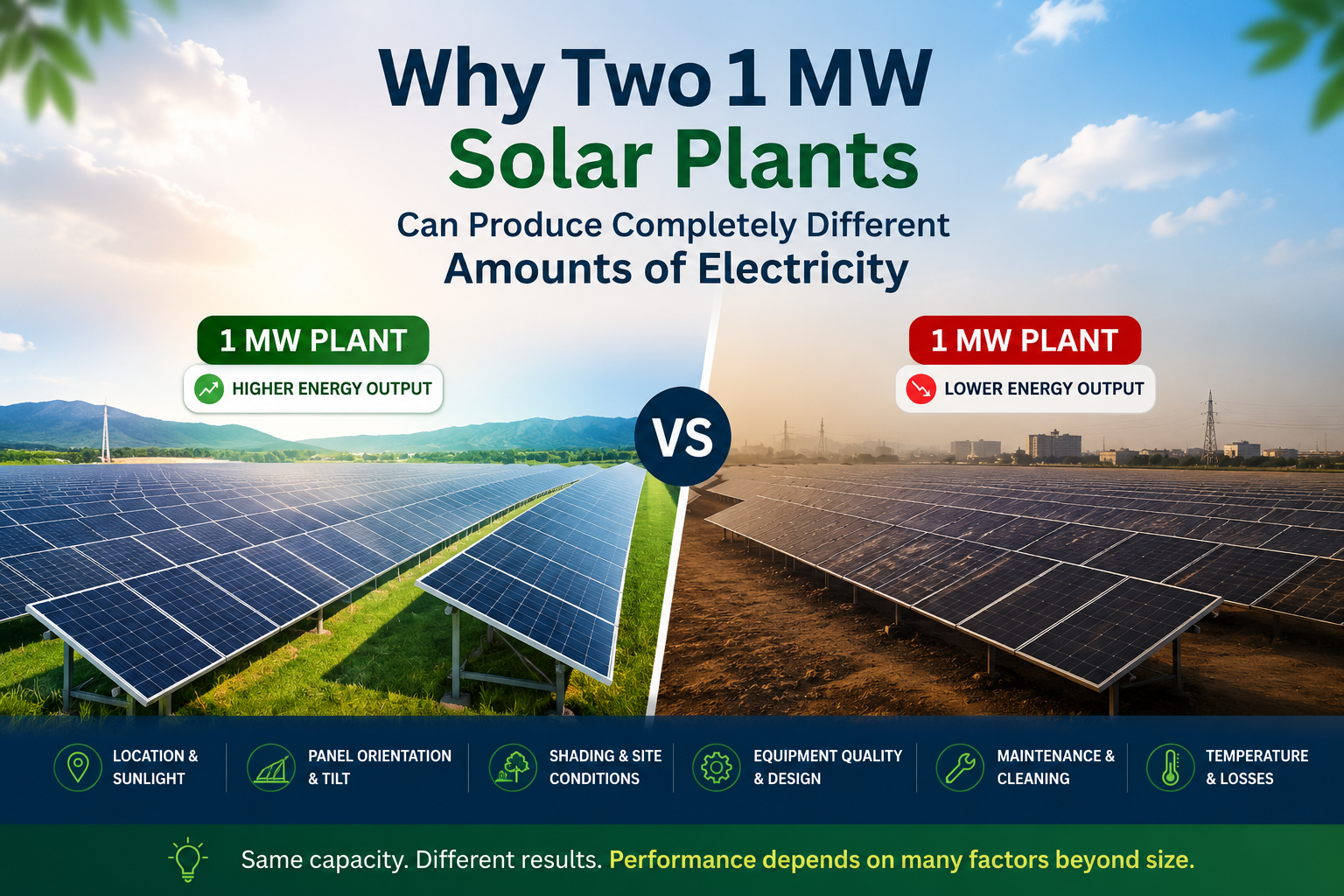
Why Two 1 MW Solar Plants Can Produce Completely Different Amounts of Electricity
At first glance, a 1 MW solar plant sounds simple.
If two solar plants are both rated at 1 MW, shouldn't they produce almost the same amount of electricity?
Not necessarily.
Two plants can have the same installed capacity and still generate noticeably different amounts of energy over a month, a year, or even over their entire operating life.
The reason is simple:
A solar plant's capacity tells you what it can produce under defined conditions. It does not tell you how much energy it will actually produce every day.
This distinction is one of the most important things businesses, industries, institutions and project owners should understand before investing in a solar power plant.
1 MW plant installed on one site may outperform another 1 MW plant because of better site conditions, system design, equipment selection, installation quality, monitoring, maintenance and energy-loss management.
So, when comparing solar projects, the question shouldn't simply be:
"How many megawatts is the plant?"
A better question is:
"How effectively does the plant convert available sunlight into usable electricity?"
Let's look at what really creates that difference.
1. MW Is the Size of the Plant — Not Its Daily Output
One of the most common misunderstandings about solar power is confusing capacity with energy generation.
A 1 MW solar plant has a rated capacity of 1 megawatt under specified test conditions.
But sunlight isn't constant.
The intensity of sunlight changes throughout the day. It changes with the season, weather, atmospheric conditions, temperature, shading and other environmental factors.
A plant may generate:
- Very little electricity around sunrise
- Increasing electricity as sunlight becomes stronger
- Its highest output around the strongest solar period
- Declining output in the afternoon
- Almost no solar generation after sunset
Therefore, a 1 MW plant does not continuously produce 1 MW for 24 hours.
This is why evaluating a solar project requires looking at energy generation over time, rather than only its installed capacity.
2. The First Difference Begins Before Installation
The performance difference between two solar plants can begin long before a single panel is installed.
It begins with the site.
Solar projects are highly dependent on their location.
Two sites may have identical 1 MW systems but completely different solar resources.
Factors such as:
- Solar irradiation
- Weather patterns
- Temperature
- Humidity
- Dust
- Nearby structures
- Trees
- Buildings
- Terrain
- Shading
- Available installation area
can influence the final energy yield.
This means site evaluation is not simply about finding a large empty roof or piece of land.
It is about understanding how that location behaves throughout the year.
3. Same Sunlight Does Not Always Mean Same GenerationEven if two plants receive similar sunlight, their generation may still differ.
Why?
Because sunlight is only the beginning of the conversion process.
The energy passes through multiple stages before it becomes usable electricity.
A simplified journey looks like this:
Sunlight → Solar Module → DC Electricity → DC Collection → Inverter → AC Electricity → Electrical Distribution → Load/Grid
Every stage can introduce losses.
A well-designed solar plant attempts to minimize unnecessary losses at every point.
This is why engineering matters.
4. Solar Module Selection Can Change the Result
Not all modules behave exactly the same way.
Module technology, efficiency, temperature characteristics, degradation rate and manufacturing quality can influence long-term performance.
For example, two projects may use modules with the same nominal capacity but different electrical and thermal characteristics.
One system may perform better under certain operating conditions.
Module selection should therefore consider more than the nameplate wattage.
Important questions include:
- How efficient are the modules?
- How do they perform at higher temperatures?
- What is their expected degradation?
- What certifications do they carry?
- What is their warranty structure?
- How consistent is the manufacturing quality?
- How suitable are they for the site's environmental conditions?
A cheaper module is not automatically a cheaper solution over the plant's operating life.
5. Temperature: The Invisible Performance Factor
Solar panels need sunlight to generate electricity.
But there is an interesting contradiction:
More intense sunlight often means higher module temperature, and higher module temperature can reduce electrical performance.
Solar modules are generally tested under standardized conditions.
Actual outdoor conditions are different.
On a hot afternoon, the temperature of the module can become significantly higher than the surrounding air temperature.
This means two plants operating in different thermal conditions can produce different amounts of electricity even when their installed capacities are identical.
Good system design takes temperature behavior into consideration.
6. The Roof or Land Layout Matters
Imagine two 1 MW plants.
One has a carefully planned layout with minimal shading and optimized spacing.
The other has panels packed into available spaces without sufficient attention to shading, maintenance access or orientation.
Both may have the same capacity.
But their performance may not be the same.
Solar plant layout involves much more than fitting the maximum number of panels into a space.
Engineers must consider:
- Panel orientation
- Tilt
- Row spacing
- Shading
- Access pathways
- Structural limitations
- Wind conditions
- Drainage
- Maintenance requirements
- Cable routing
A slightly less crowded design can sometimes produce better long-term results than a design focused purely on maximum panel density.
7. The Shadow That Costs More Than You Think
Shading is one of the most important issues in solar design.
A shadow from a nearby building, tree, water tank, parapet wall, tower or even another row of modules can reduce energy production.
And the problem isn't always obvious.
A roof may look completely open at 11 AM.
But what happens at 8 AM?
What happens at 4 PM?
What happens during winter?
What happens when the sun's position changes throughout the year?
Professional solar design considers the movement of the sun across different periods rather than judging the site from a single observation.
8. Why String Design Matters
A solar plant isn't simply one large collection of panels.
Panels are connected into electrical groups known as strings.
These strings are then connected to inverters and other electrical equipment.
The way these strings are configured can influence system performance.
If one part of a system experiences shading, mismatch or another issue, the effect can depend on how the modules are electrically configured.
Good string design aims to ensure that the plant operates efficiently under expected site conditions.
This is another reason why two plants with identical panel capacity can have different real-world performance.
9. The Inverter Is More Than a Box
Solar modules generate DC electricity.
Most commercial and industrial electrical systems use AC electricity.
The inverter performs the critical job of converting DC into AC.
But modern inverters do much more than conversion.
They can also provide:
- System monitoring
- Fault detection
- Performance information
- Protection functions
- Grid interaction
- Operational data
- Efficiency tracking
The inverter's operating characteristics, configuration and efficiency can therefore have an important effect on the overall plant.
Selecting an inverter should not simply be a matter of choosing a convenient brand or matching a number on a quotation.
It should be part of the overall system design.
10. DC Losses and AC Losses Add Up
Every solar plant experiences some level of electrical loss.
The important objective is not to assume that losses can be eliminated completely.
The objective is to control and minimize them.
Losses can occur because of:
- Cable resistance
- Connector losses
- Module mismatch
- Inverter conversion
- Transformer losses
- Electrical equipment
- Temperature
- Soiling
- Shading
- System availability
One small loss may not appear significant.
But when several losses occur together, the combined impact can become substantial.
This is why solar plant design requires looking at the complete electrical pathway.
11. A Dirty Panel Is Not Just a Dirty Panel
Dust is especially relevant in many Indian operating environments.
A layer of dust or dirt on a module can reduce the amount of sunlight reaching the cells.
But the effect varies depending on:
- Type of dust
- Thickness of accumulation
- Local climate
- Rainfall
- Wind
- Nearby industrial activity
- Agricultural activity
- Traffic
- Cleaning frequency
A solar plant near a dusty industrial environment may behave very differently from one installed in a cleaner environment.
This means cleaning schedules should be based on actual site conditions rather than simply following a fixed calendar.
12. Rain Can Help — But It Doesn't Solve Everything
Rain naturally washes some dust from solar panels.
However, rainfall does not necessarily mean complete cleaning.
Dust can combine with moisture and leave deposits on the surface.
Bird droppings, industrial particles and other contaminants can also remain after rainfall.
Therefore, relying entirely on rain may not always be enough for maintaining optimum plant performance.
The correct approach is to understand the site's actual soiling pattern and monitor its effect on generation.
13. Monitoring Turns a Solar Plant Into a Measurable Asset
A modern solar plant should not operate like a machine that is switched on and then forgotten.
Monitoring provides visibility into what the plant is actually doing.
Useful data can include:
- Daily energy generation
- Monthly generation
- Inverter performance
- String-level information
- Plant availability
- Performance ratio
- Fault alerts
- Historical generation
- Irradiance data
- Weather information
This data allows operators to compare expected performance with actual performance.
And that comparison is extremely valuable.
14. The Most Dangerous Problem Is Sometimes the One Nobody Notices
A major equipment failure is easy to notice.
The plant stops generating.
But a gradual performance decline can be much harder to identify.
Suppose a plant is generating slightly less energy than expected every day.
There may be no dramatic alarm.
The lights are still on.
The inverters may still be operating.
The plant may appear normal.
But over a long period, the lost generation can become significant.
This is why performance monitoring is important.
The goal isn't merely to know when the plant has failed.
The goal is to identify when the plant is underperforming.
15. Preventive Maintenance vs Reactive Maintenance
There are two ways to approach maintenance.
The first is reactive:
Something fails → identify the problem → repair it.
The second is preventive:
Monitor the plant → identify abnormal behavior → investigate → correct the issue before it becomes a major failure.
For a large solar plant, preventive thinking can be valuable because every period of reduced availability represents potentially lost generation.
Maintenance should therefore be considered part of plant performance management rather than simply an expense.
16. The Importance of Electrical Protection
Solar generation systems contain significant electrical infrastructure.
Protection equipment plays an important role in protecting people and equipment from electrical faults and abnormal conditions.
Depending on the system, this may involve:
- Surge protection
- Circuit breakers
- Fuses
- Earthing
- Lightning protection
- Isolation equipment
- Protection relays
- Appropriate electrical coordination
These components may not be the most visible part of a solar project.
But they are essential to safe and reliable operation.
A solar plant should therefore be evaluated as a complete electrical system rather than simply a collection of photovoltaic modules.
17. Earthing: The Infrastructure You Don't See
One of the least glamorous parts of a solar plant is also one of the most important.
Earthing and bonding provide essential electrical safety and protection functions.
A professionally designed system needs appropriate earthing arrangements for the different equipment and structures involved.
It isn't something that should be treated as an afterthought.
Good solar engineering includes the components people see as well as the components they never notice.
18. Installation Quality Can Separate Two Identical Projects
Imagine two projects using:
- The same module capacity
- The same inverter capacity
- Similar site conditions
- Similar equipment
Yet one plant performs better.
Installation quality may be one of the reasons.
Cable management, connector installation, mounting alignment, torque practices, electrical terminations, waterproofing and workmanship can all influence long-term reliability.
The quality of the equipment matters.
But the quality of the installation matters too.
19. Solar Plant Performance Is a Team Sport
A solar plant doesn't depend on one component.
It depends on the interaction between many components.
Think of it like a chain.
If one part performs poorly, the overall system can be affected.
Modules → Strings → Combiner/Protection → Inverters → Transformer → Distribution → Monitoring
The strongest solar projects treat these as one integrated system.
20. Why Performance Ratio Matters
One of the useful indicators for evaluating a solar plant is Performance Ratio (PR).
PR helps compare the actual energy output of a solar plant against the theoretical energy available from the solar resource, while accounting for system characteristics and losses.
It helps answer a more meaningful question than simply:
"How many units did the plant generate?"
The better question is:
"How effectively did the plant convert the available solar resource into electricity?"
This is particularly useful when comparing plant performance across different periods or evaluating whether a system is operating as expected.
21. The Business Side: Every Lost Unit Has a Value
For a commercial or industrial solar project, electricity isn't simply a technical output.
It has financial value.
Every unit of energy generated can represent avoided electricity purchases, depending on the project's configuration and tariff structure.
That means underperformance has an economic consequence.
If a solar plant consistently generates less than expected, the impact isn't only visible on a monitoring dashboard.
It can eventually appear in the project's financial results.
This is why energy yield should be treated as a business metric as well as an engineering metric.
22. Why the Cheapest 1 MW Plant May Not Be the Cheapest Project
Imagine two proposals.
Proposal A
Lower initial price.
Proposal B
Slightly higher initial investment with better engineering, equipment selection, monitoring and maintenance support.
If Proposal A produces less energy or experiences more downtime over the years, its lower initial price may not make it the better investment.
This is why comparing solar projects purely on ₹ per watt can be misleading.
A better evaluation considers:
- Expected annual generation
- Equipment quality
- System design
- Performance assumptions
- Warranty
- Availability
- O&M support
- Monitoring
- Expected degradation
- Long-term energy yield
The cheapest system and the most economical system are not always the same thing.
23. The Role of Degradation
Solar modules don't remain exactly at their original performance forever.
Their output gradually changes over time.
This is known as degradation.
Module technology, environmental conditions and product quality can influence the rate.
Therefore, a solar project should be evaluated not only based on its first-year generation but also on how it is expected to perform over the long term.
A good project looks beyond Year One.
24. Solar Plants Need to Be Designed for the Site — Not Just for the Capacity
A common approach is:
"We need 1 MW. Give us a 1 MW solar plant."
But capacity is only one part of the design problem.
A better approach is:
"What does this site need, what can this site support, and how can we maximize reliable energy generation from it?"
That shift in thinking can influence:
- Module selection
- Inverter selection
- Plant layout
- Tilt and orientation
- Electrical configuration
- Cable sizing
- Mounting structure
- Monitoring
- Maintenance strategy
The best design is not necessarily the one with the most equipment.
It is the one that makes the equipment work together effectively.
25. What Happens During Extreme Weather?
A solar plant operates outdoors.
That means it must deal with environmental conditions throughout its operating life.
Depending on location, this can include:
- Heavy rain
- Strong winds
- High temperatures
- Dust
- Humidity
- Lightning
- Storms
- Coastal conditions
A plant designed for one environment may require different considerations in another.
For example, a coastal installation may face different environmental challenges from an inland industrial site.
This is why location-specific engineering matters.
26. Solar Plant Design Should Include the Future
A solar plant should not only be designed for the day it is commissioned.
It should also be designed with future operation in mind.
Can technicians safely access the equipment?
Can modules be cleaned?
Can failed equipment be replaced?
Can faults be isolated?
Can monitoring data be accessed?
Can the electrical system be inspected?
Can maintenance vehicles reach the required areas?
These questions may not directly increase the plant's capacity.
But they can make the plant easier and safer to operate over the long term.
27. The Difference Between a Solar Installation and a Solar Asset
This is perhaps the most important distinction.
A solar installation is a project that has been completed.
A solar asset is a project that continues delivering measurable value over time.
The difference comes from what happens after commissioning.
A solar asset is:
- Monitored
- Maintained
- Measured
- Optimized
- Inspected
- Evaluated against expectations
That is how a solar plant becomes a long-term energy asset rather than simply a collection of equipment.
28. The Real Question Isn't "How Big Is Your Plant?"
When someone says:
"We have a 1 MW solar plant."
That tells us the plant's capacity.
But it doesn't tell us everything we need to know.
To understand its real performance, we should ask:
How much energy does it generate?
What is its performance ratio?
How much downtime does it experience?
What are its major system losses?
How does current generation compare with expected generation?
How is the plant monitored?
What maintenance strategy is being followed?
These questions reveal much more about a solar project's actual quality.
29. From Megawatts to Meaningful Energy
The future of solar is not simply about installing more megawatts.
It is about getting more value from every megawatt already installed.
That means improving:
- Engineering
- Equipment selection
- Installation
- Monitoring
- Maintenance
- Data analysis
- Reliability
- Energy management
As commercial and industrial organizations increasingly use solar to manage energy costs, the quality of the plant becomes just as important as its size.
30. The Solar Plant Is Only as Good as Its Performance
Two 1 MW plants can sit under the same sun and still tell completely different stories.
One may suffer from poor design.
Another may have excessive shading.
One may have higher electrical losses.
Another may have inconsistent maintenance.
One may be difficult to monitor.
Another may provide detailed real-time performance data.
And one may simply be engineered better from the beginning.
That is why the number 1 MW should never be the end of the conversation.
It should be the beginning.
The real value of a solar project comes from how efficiently, safely and consistently that capacity is converted into useful electricity.
Conclusion: Don't Just Install Capacity. Build Performance.
Solar power is often measured in megawatts.
But businesses ultimately benefit from something different:
usable energy.
A 1 MW solar plant is a significant investment, but its true value is determined by what it delivers after installation.
From site assessment and module selection to inverter configuration, electrical design, installation quality, monitoring and maintenance, hundreds of decisions influence the final result.
That is why a successful solar project should never be judged only by the number written on its quotation.
The better question is:
"How much reliable energy will this plant deliver, and how well will it continue to perform?"
At Daystar Solar, the focus should not simply be on installing solar capacity. The bigger objective is to approach every project as a long-term energy asset — where design, engineering, quality and performance work together.
Because the real achievement isn't installing 1 MW.
The real achievement is making that 1 MW work intelligently, reliably and efficiently for years to come.
Daystar Solar — Building Solar Systems With Performance in Mind.
"For commercial, industrial and large-scale solar projects, professional system design and performance-focused engineering can make a meaningful difference to long-term energy generation."