When we think about solar power, one idea seems obvious:
The sun is strongest at noon, so a solar plant must generate its maximum power at 12:00 PM.
But real solar plants do not always behave that way.
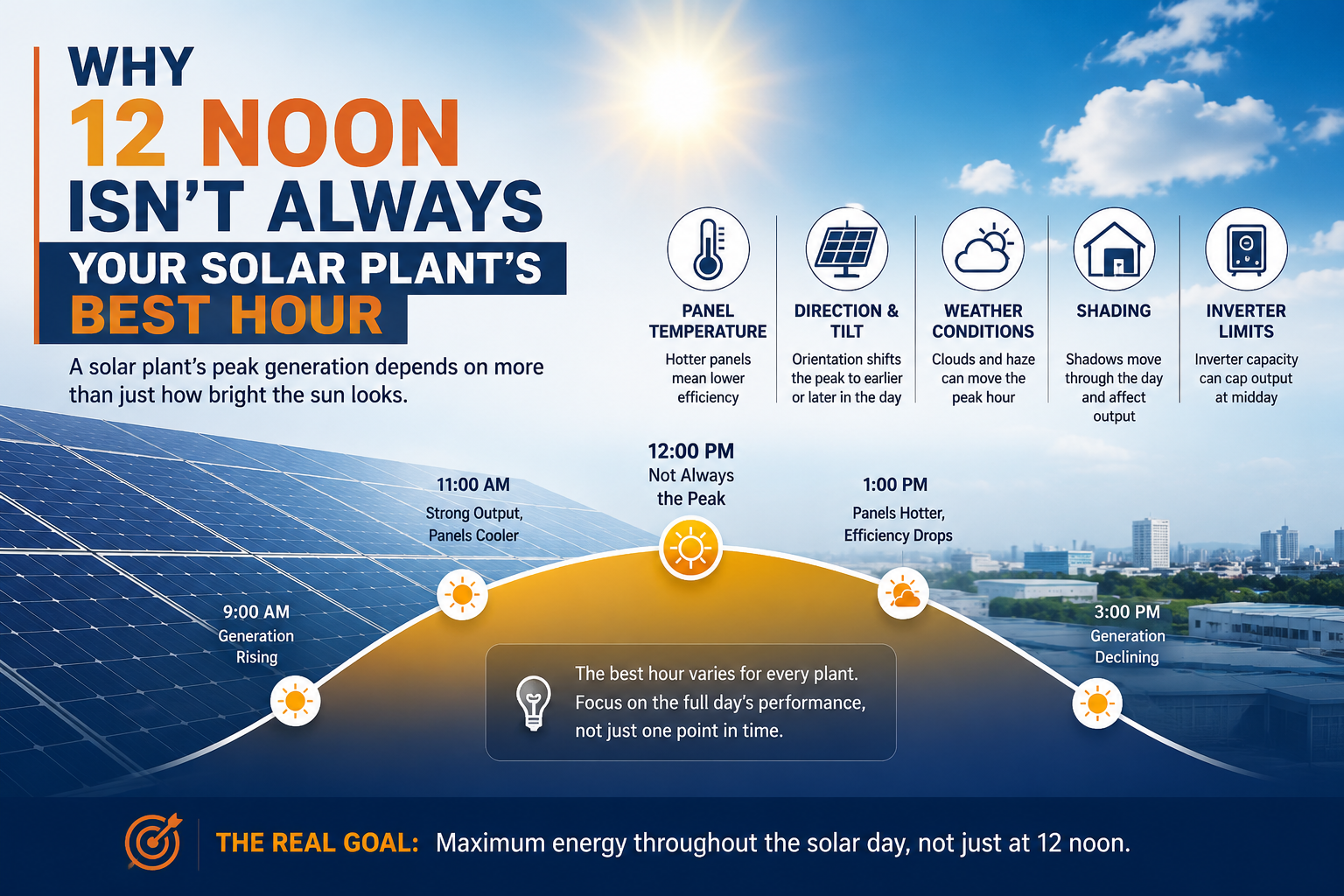
A solar plant’s best-performing hour depends on much more than how bright the sky looks. Panel temperature, orientation, tilt, weather, inverter capacity, shading and even the geographical location of the plant can shift the actual peak generation to before or after noon.
Understanding this can help businesses evaluate their solar plant more accurately instead of judging performance based on a single time of day.
First, 12:00 PM Is Not Necessarily “Solar Noon”
Clock time and solar time are not exactly the same.
Solar noon is the moment when the sun reaches its highest position in the sky for a particular location. Depending on longitude, date and time-zone positioning, this moment may occur before or after 12:00 PM.
NOAA's solar calculations show that solar noon is determined using both location and the “equation of time,” meaning the sun's highest point does not automatically occur at exactly 12:00 on the clock.
So even before considering solar-panel technology, the idea that 12:00 PM must equal peak solar conditions is already an oversimplification.
More Sunlight Doesn't Always Mean More Output
Solar panels need sunlight, but there is another important factor:
Temperature.
PV modules are generally rated under Standard Test Conditions, which include a cell temperature of 25°C.
Actual rooftop solar panels can become considerably hotter during operation.
NREL's PVWatts model accounts for this by reducing expected DC output as cell temperature rises according to the module's temperature coefficient.
This creates an interesting situation.
Imagine:
11:00 AM
Strong sunlight
Panels are relatively cooler
Good operating efficiency
1:00 PM
Slightly stronger or similar sunlight
Panels have become much hotter
Temperature-related efficiency losses increase
The result?
The plant could potentially record its highest power before the hottest part of the afternoon.
That is why:
Brightest does not always mean most efficient.
Your Panel Direction Changes the Generation Curve
The orientation of a solar array strongly influences when it produces the most power.
An east-facing array receives stronger direct sunlight earlier in the day.
A west-facing array receives stronger sunlight later in the afternoon.
A suitably oriented south-facing system in the Northern Hemisphere generally produces a more balanced profile around the middle of the day.
The U.S. Department of Energy notes that west-facing PV arrays can shift energy production later into the day compared with south-facing systems.
So two solar plants installed in the same city could have different peak-generation times simply because their panels face different directions.
This is especially important for commercial and industrial plants where roof design may require multiple orientations.
The Roof Itself Can Decide the Best Hour
Consider a commercial building with several rooftop sections.
One section may face southeast.
Another may face southwest.
Another may have a slightly different tilt.
Instead of one sharp generation peak at noon, the combined plant may produce a broader generation curve stretching across several hours.
And that can actually be beneficial.
For many businesses, producing usable solar energy over a longer portion of the working day may be more valuable than achieving one very high instantaneous peak.
Heat Can Change the Midday Advantage
Solar panels convert sunlight into electricity.
They do not convert heat into electricity.
This distinction matters enormously in hot climates.
NREL's performance research notes that PV production is affected by both solar resource and module temperature, and real operating cell temperatures are often higher than the 25°C reference condition used for module ratings.
This means an extremely hot, cloudless afternoon does not automatically guarantee the plant's highest efficiency.
Strong sunlight helps generation.
Excessive panel temperature works in the opposite direction.
The real output is the result of both effects happening at the same time.
Clouds Can Move the Peak
Weather adds another variable.
Imagine a perfectly sunny morning followed by temporary clouds around noon.
Even though noon normally offers excellent solar conditions, the plant's generation could temporarily fall.
If the clouds clear at 1:30 PM, the day's actual peak may occur then instead.
Cloud movement, haze, humidity and atmospheric conditions can continuously reshape the plant's generation curve.
That is why solar performance should normally be evaluated using daily, monthly and annual generation, rather than checking one reading at noon.
Shadows Have Their Own Schedule
A shadow is not stationary throughout the day.
Water tanks, nearby buildings, trees, antennas, parapet walls and other rooftop structures can cast shadows across solar modules at different times.
A plant could receive excellent sunlight at 11:00 AM but experience partial shading around 12:30 PM.
Later, as the sun moves, the shadow may disappear again.
The position of the sun relative to the array therefore matters just as much as the apparent brightness outside.
Sometimes the Inverter Sets the Limit
There is another interesting reason midday may not show a dramatic production peak.
The solar array's DC capacity can sometimes be higher than the inverter's maximum AC output capacity.
When extremely strong sunlight causes the array to produce more DC power than the inverter can convert, the inverter can temporarily limit output.
This is known as inverter clipping.
NREL explains that some solar systems are intentionally designed with DC capacity greater than inverter AC capacity so they can generate more energy during lower-light periods, even though some output may occasionally be clipped during peak-sun conditions.
So the generation graph might look like this:
Morning → rising
Late morning → rising
Midday → flat
Afternoon → falling
That flat section does not necessarily mean something is wrong. It can sometimes be a result of system design.
Then What Is the “Best Hour” for a Solar Plant?
There is no universal answer.
For one plant, it may be 11:30 AM.
For another, 12:20 PM.
For another, 1:00 PM.
And for some plants, identifying one “best hour” may not even be the most useful measurement.
A better question is:
“How well is the plant performing throughout the entire solar day?”
A healthy solar plant normally develops a predictable generation pattern according to its design, location and weather conditions.
Instead of chasing a particular noon reading, businesses should monitor:
Daily energy generation
Expected versus actual generation
Hourly generation curves
Panel temperature
Inverter performance
Shading
System downtime
Weather conditions
Month-to-month performance
Long-term performance trends
The Bigger Lesson
Solar performance is not simply:
More sunlight = more electricity.
It is closer to:
Sunlight + temperature + orientation + tilt + weather + equipment + system design = actual generation.
That is why professional solar monitoring matters.
A solar plant may look perfectly normal from the rooftop while its generation data tells a completely different story.
And sometimes the most important information about your solar plant isn't found by looking at the sun.
It is found by looking at the generation curve.
Final Thought
12 noon may look like the most powerful moment of the solar day.
But solar plants don't follow the clock.
They follow physics.
Understanding when and why your plant reaches peak generation can help identify performance issues, improve energy utilisation and ensure that your solar investment continues delivering the output it was designed for.