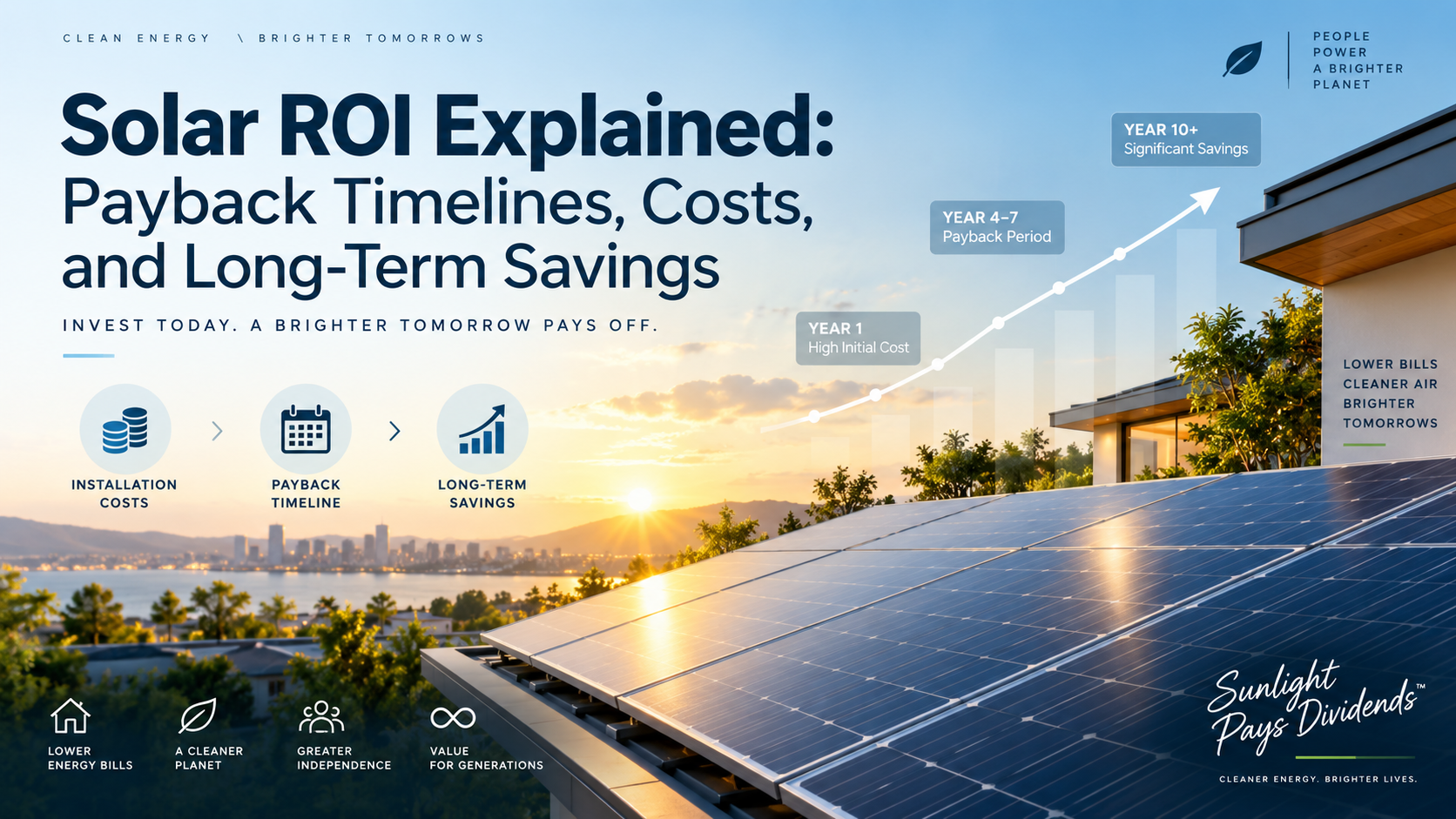
Everyone wants to know one thing before they go solar: when do I actually get my money back?
It's a fair question, and also the wrong one to ask first. Most homeowners fixate on payback period alone, then get disappointed or misled depending on which number a salesperson hands them. Having looked at dozens of installations and cost breakdowns, my honest take is this: the people who are happiest with their solar investment are the ones who understood ROI as a system — not as a single magic number on a brochure.
That system is built from a few moving parts:
Panel and installation cost
Financing method
Available incentives and tax credits
Household energy usage
Local electricity rates
Get that system right, and solar isn't just an environmental choice. It's one of the few home investments that pays you back in cash, year after year, for decades.
What "Solar ROI" Actually Means
Return on Investment for solar is simple in concept: how much you save (or earn) from your system, divided by what you spent to install it.
But the inputs behind that number vary wildly by home, by region, and by how the system is financed. Two identical roofs with identical panels can have completely different ROI timelines depending on:
Local electricity rates - the higher your utility rates, the faster solar pays for itself
Sunlight hours and roof orientation - more usable sunlight means more generation per panel
Incentives and tax credits available - in your region
Financing method - cash purchase, loan, or lease all produce very different returns
System size relative to actual household usage - oversized systems take longer to pay back
This is why "solar pays for itself in 6 years" and "solar pays for itself in 12 years" can both be true statements — just for different households.
Factor | Effect on ROI |
High local electricity rates | Faster payback |
South-facing, unshaded roof | Higher generation, faster payback |
Strong net metering policy | Higher effective savings |
Correctly sized system | Optimized payback timeline |
Oversized system | Slower payback |
The Real Payback Timeline (Not the Marketing Version)
Most residential solar systems pay for themselves in 6 to 10 years, with panels typically warrantied for 25 years and often still producing meaningful power beyond that.
Stage | Timeframe | What Happens |
Initial investment | Year 0–1 | Installation cost paid, often offset by tax credits |
Repayment phase | Year 1–7 | Monthly electricity savings repay the initial cost |
Pure savings phase | Year 7–25+ | Nearly all savings go straight to your pocket |
Post-warranty | Year 25+ | Panels typically still run at 80–85% efficiency |
The critical insight most people miss: the first few years look unimpressive, and the last fifteen look excellent. Judging solar ROI by year two is like judging a retirement account by its first statement.
Cash Purchase vs. Loan vs. Lease: Three Very Different ROI Stories
Financing Method | Upfront Cost | Ownership | Tax Credit Eligibility | Long-Term ROI |
Cash purchase | High | Yes | Yes | Highest |
Solar loan | Low to none | Yes | Yes | Moderate to high |
Lease / PPA | None | No | No | Low |
If maximizing ROI is the actual goal, ownership — whether through cash or a loan — wins in almost every scenario. Leases exist to remove the upfront barrier, not to maximize returns.
What Actually Moves the ROI Needle
In my experience, three factors separate a mediocre solar investment from a genuinely great one:
Right-sizing the system - Oversized systems waste money generating power you don't use (unless net metering is strong in your area). Undersized systems leave savings on the table.
Net metering policy in your area - Where utilities credit excess solar generation at full retail rate, ROI improves dramatically. Where they don't, battery storage or self-consumption strategies matter more.
Timing incentives correctly - Tax credits, rebates, and depreciation schedules shift the entire payback curve, sometimes by years.
Looking Ahead
Solar ROI isn't a fixed number you can look up — it's a calculation that depends on your roof, your rates, your financing, and your local policy environment. The homeowners who get the best returns are the ones who treat it like any other long-term financial decision: they run the numbers for their specific situation rather than trusting a generic payback estimate.
The direction is clear, though:
Electricity rates are rising in most regions
Panel costs continue to fall
Payback timelines are shrinking, not stretching
The question isn't really "will solar pay for itself" anymore — it's "how much faster can I make it pay for itself."
Frequently Asked Questions
1. What is a good ROI for a solar panel system?
Most homeowners consider 10–20% annual ROI (based on electricity savings) to be strong, with full payback in 6–10 years being typical.
2. How is solar ROI calculated?
ROI = (Total energy savings + incentives − System cost) ÷ System cost, usually calculated over a 20–25 year period to reflect the system's lifespan.
3. Does solar panel efficiency degrade over time?
Yes, but slowly — typically 0.5% per year. Most panels still produce 80–85% of original output after 25 years.
4. Do solar panels increase home value?
In most markets, yes. Owned (not leased) solar systems are commonly associated with a resale value increase, though the exact premium varies by region and buyer demand.
5. What incentives affect solar ROI?
Federal tax credits, state rebates, net metering policies, and local utility incentives all directly affect payback time — and they vary significantly by location.
6. Is solar worth it if I finance with a loan instead of paying cash?
Often yes, especially if your monthly loan payment is lower than your previous electricity bill — you can start saving from month one, just at a slower overall ROI rate than a cash purchase.
7. How does a solar lease affect ROI compared to buying?
Leases and PPAs typically offer little or no ROI to the homeowner, since the leasing company retains ownership, tax credits, and most long-term savings.
8. What is net metering, and why does it matter for ROI?
Net metering lets you sell excess solar energy back to the grid, often at retail rate. Strong net metering policies significantly shorten payback periods; weak ones make battery storage more valuable.
9. Do I need a battery to get good solar ROI?
Not necessarily. In areas with strong net metering, batteries add cost without dramatically improving ROI. In areas with weak or no net metering, batteries can meaningfully improve returns.
10. How does roof direction and shading affect ROI?
South-facing (in the Northern Hemisphere) unshaded roofs produce the most energy and the fastest ROI. Partial shading or east/west orientation can extend payback time by 20–40%.
11. What happens to ROI if electricity rates rise after I install solar?
It improves. Since solar locks in your generation cost, rising utility rates increase the value of the electricity you're no longer buying, accelerating your effective ROI.
12. Is solar ROI different for businesses than for homeowners?
Yes — commercial solar often benefits from additional depreciation incentives and typically sees faster payback due to higher energy consumption and available commercial tax benefits.
13. How long do solar panels actually last?
Most are warrantied for 25 years and can continue functioning meaningfully beyond that, often 30+ years, just at reduced efficiency.
14. What's the biggest mistake people make when estimating solar ROI?
Oversizing the system for their actual usage, or comparing ROI only over the first 2–3 years instead of the system's full lifespan.
15. Can I calculate my personal solar ROI before installing?
Yes — using your utility rate, roof specifics, local incentive programs, and a quote from an installer, most solar companies (and several free online calculators) can generate a personalized ROI estimate.