Installing a solar power system is one of the most effective ways for businesses to reduce electricity costs and improve long-term energy savings.
But installing solar is only the beginning.
A solar plant may continue generating electricity every day, yet the business could still be losing valuable savings without realizing it.
This happens when the system performs below its expected potential.
For commercial and industrial solar plants, even a small percentage of performance loss can become a significant financial loss over time.
That is why businesses should not only ask:
“Is the solar plant generating power?”
They should also ask:
“Is the solar plant generating as much value as it should?”
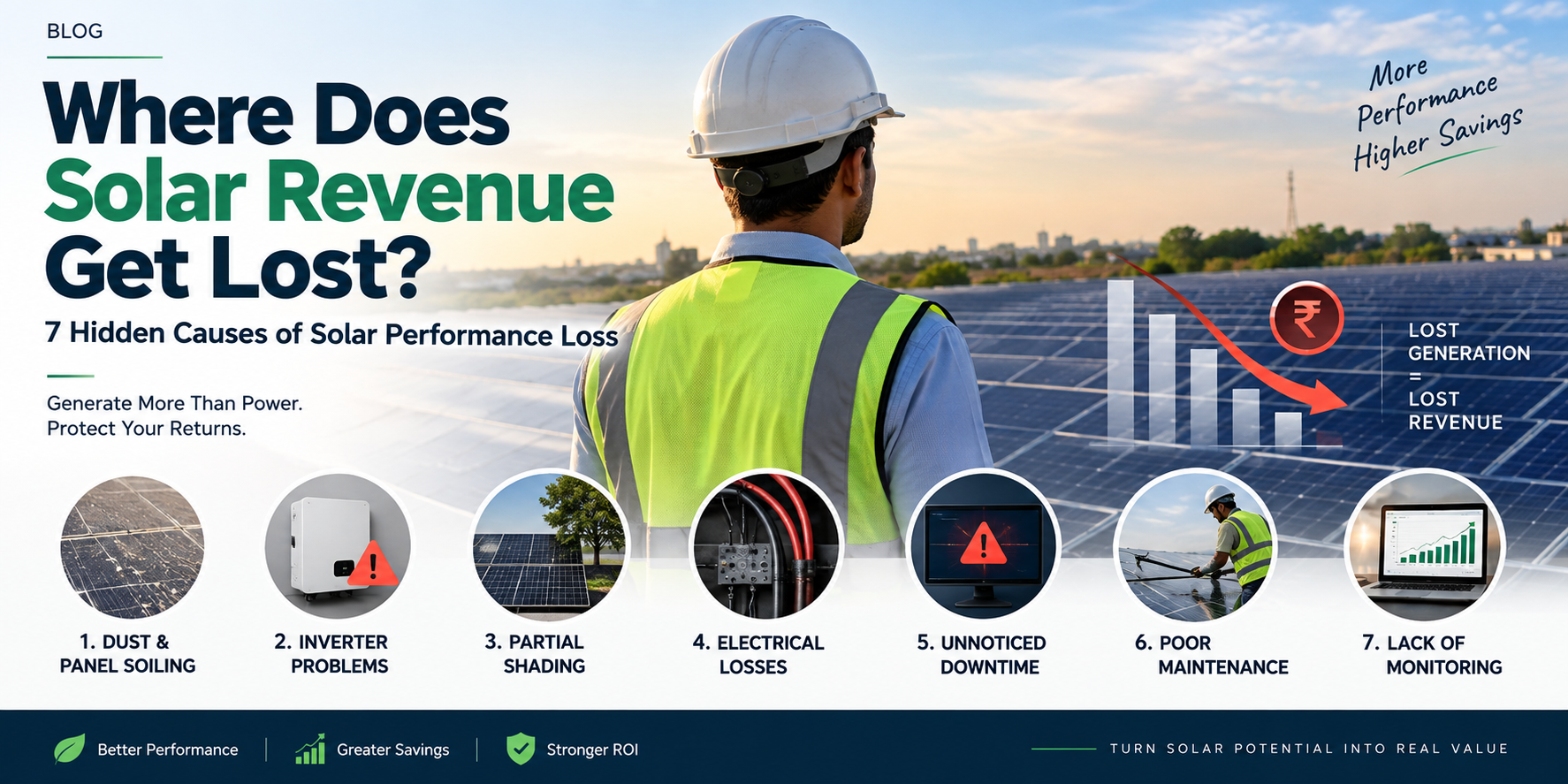
1. Dust and Panel Soiling
Solar panels depend on direct sunlight.
When dust, dirt, bird droppings, industrial pollution, leaves, or other particles accumulate on the panel surface, less sunlight reaches the solar cells.
This reduces generation.
In industrial areas, dusty locations, or dry climates, soiling can build up quickly.
The solar plant may still appear to be operating normally, but its output may slowly decrease.
Regular panel inspection and proper cleaning can help recover lost generation and maintain better performance.
2. Inverter Inefficiency and Shutdowns
The inverter is one of the most important components in a solar power system.
It converts the DC electricity generated by the solar panels into usable AC electricity.
If the inverter is overheating, frequently tripping, operating below efficiency, or experiencing internal faults, the entire system can lose generation.
Even short inverter shutdowns during peak sunlight hours can affect daily production.
Monitoring inverter performance and responding quickly to faults can help reduce these losses.
3. Partial Shading
Shading can reduce solar output significantly.
Trees, nearby buildings, water tanks, towers, new construction, or rooftop equipment can create shadows over parts of the solar array.
This may not have been a problem when the system was first installed.
But over time, changes around the site can create new shading conditions.
Regular site inspections can help identify these issues early.
4. Electrical and Wiring Losses
A solar plant contains many cables, connectors, terminals, junction boxes, and electrical components.
Loose connections, damaged cables, overheating, corrosion, and faulty connectors can increase electrical losses.
These issues can reduce generation and may also create safety risks.
Routine electrical inspections are therefore essential for both performance and system reliability.
5. Unnoticed Downtime
Every hour that a solar system remains offline during daylight hours represents lost generation.
Downtime can be caused by:
Inverter trips
Grid failures
Electrical faults
Protection system activation
Communication errors
Equipment failures
The biggest problem is that some faults may remain unnoticed.
Without proper monitoring, a system could operate at reduced capacity for hours or even days.
Remote monitoring and quick technical response can help minimize this loss.
6. Poor Preventive Maintenance
Many solar plant owners wait until something fails before taking action.
This approach can lead to larger and more expensive problems.
Preventive maintenance focuses on identifying issues before they become serious.
This can include:
Solar panel inspection
Inverter inspection
Wiring checks
Structure inspection
Cleaning
Earthing checks
Fault analysis
Monitoring system review
Regular preventive maintenance helps reduce unexpected downtime and supports consistent generation.
7. Lack of Performance Monitoring
A solar plant can generate a large amount of useful performance data.
But that data has little value if it is not reviewed.
Businesses should regularly compare actual generation with expected generation.
For example, if a plant normally produces a certain amount of electricity under similar weather conditions but suddenly begins producing less, the reason should be investigated.
The cause may be dirty panels, inverter problems, shading, electrical faults, or other system losses.
Early detection helps prevent small problems from becoming long-term financial losses.
Small Energy Losses Can Become Big Financial Losses
A small daily reduction in generation may not appear serious.
But over months and years, the impact can become substantial.
For a large commercial or industrial solar plant, even a few percentage points of lost generation can translate into a significant amount of money.
This is why solar performance should always be connected to financial performance.
Every unit that is not generated may mean one more unit of electricity that needs to be purchased from the grid.
What Should Businesses Monitor?
Businesses should regularly track:
Daily and monthly generation
Expected vs actual output
Inverter performance
Plant downtime
Fault history
Cleaning records
Maintenance records
Electricity savings
Overall system performance
These indicators provide a much clearer picture of whether the solar plant is delivering its expected value.
Solar O&M Protects More Than Equipment
Operation and Maintenance should not only focus on repairing equipment.
A strong O&M strategy should also focus on protecting energy generation and financial savings.
Good solar O&M can help:
Reduce downtime
Improve plant efficiency
Detect faults early
Extend equipment life
Maintain safer operation
Protect long-term ROI
For businesses, this means better control over the solar investment.
Final Thought
Solar revenue is rarely lost because the entire system suddenly stops working.
More often, it is lost slowly through small, unnoticed performance issues.
Dust, inverter faults, shading, wiring problems, downtime, poor maintenance, and lack of monitoring can all reduce the financial value of a solar plant.
The solution is regular monitoring, preventive maintenance, timely inspection, and quick corrective action.
Do not measure your solar plant only by how much electricity it generates.
Measure it by how much value it protects.
Because every lost unit can become a lost saving.