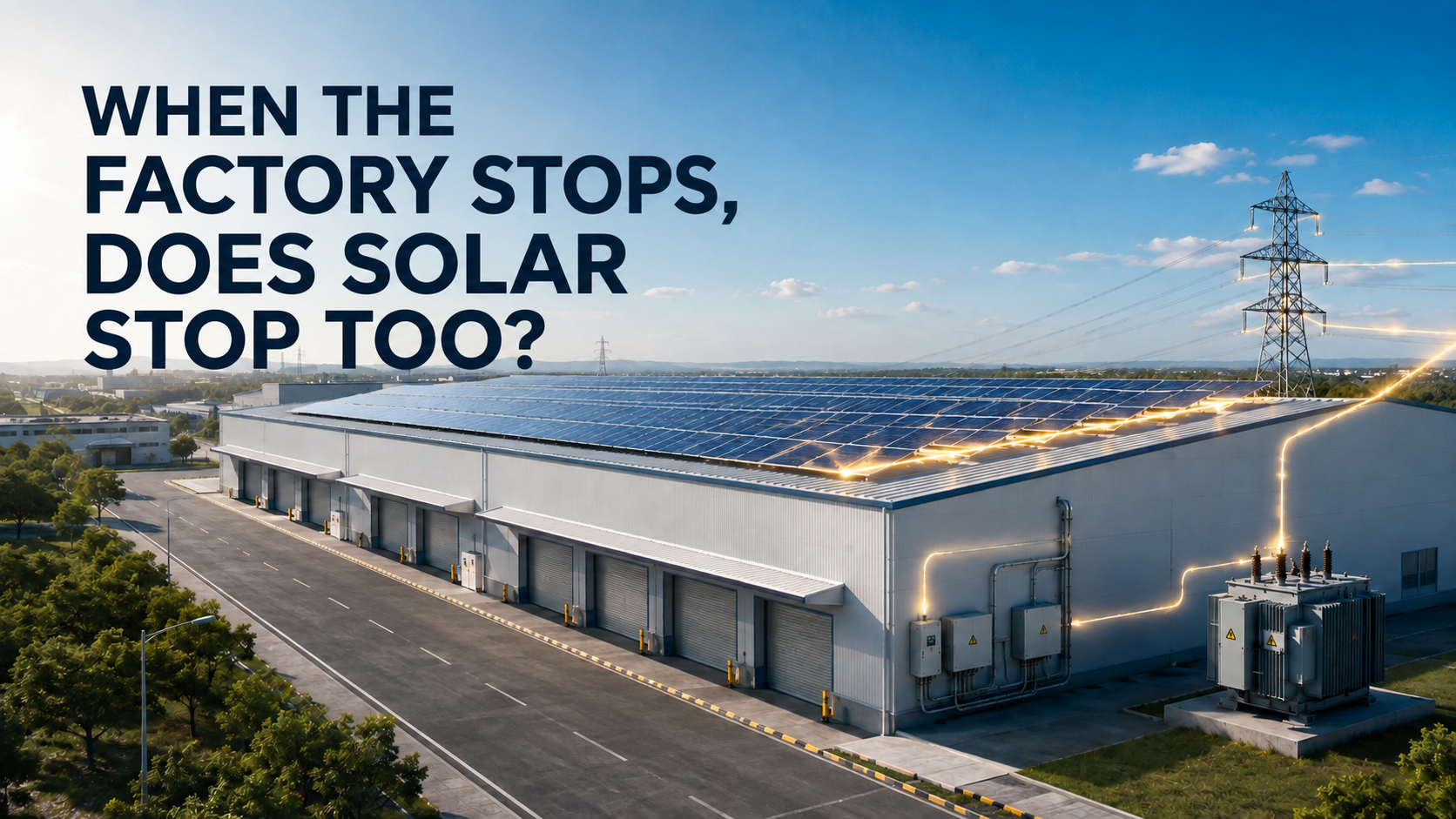
Commercial and industrial solar systems are designed to generate electricity whenever sunlight is available. But what happens when your factory is closed on a Sunday, during a holiday, or after production hours?
The solar panels do not automatically stop working just because the factory is not operating. If sunlight is available, the solar plant continues generating electricity.
The important question is: where does that electricity go?
Solar Generation Continues Even When Production Stops
A solar power plant responds to sunlight, not to the factory's working schedule.
During normal production hours, electricity generated by the solar system is usually consumed by machines, lighting, air-conditioning systems, pumps, computers and other electrical loads.
But when the factory is closed, the electrical demand can drop significantly while the solar system may continue producing power.
This creates a difference between solar generation and actual electricity consumption.
Some Power Is Still Consumed by the Factory
Even when production stops, most factories are not completely disconnected from electricity.
Certain systems may continue operating, such as:
Security systems
CCTV cameras
Servers and networking equipment
Refrigeration or cooling systems
Emergency lighting
Control panels
Pumps
Fire protection systems
Standby equipment
Solar electricity can first supply these remaining daytime loads.
However, if the solar plant produces more electricity than the factory is consuming, excess energy may remain available.
What Happens to the Excess Solar Energy?
Depending on the electrical configuration, local regulations and type of solar installation, excess solar power may be handled in different ways.
In some grid-connected installations, surplus electricity can be exported to the electricity grid where permitted.
In other installations, export may be restricted through a zero-export system. In such cases, the solar plant automatically reduces its output to prevent excess electricity from flowing into the grid.
This is why system design becomes extremely important for commercial and industrial solar projects.
Why Solar System Sizing Matters
Installing the maximum number of solar panels that can fit on a factory roof is not always the best approach.
A properly designed solar system should consider the factory's actual electricity consumption pattern.
For example, engineers may study:
Hourly electricity consumption
Peak operating hours
Weekend consumption
Holiday shutdown periods
Seasonal production changes
Available rooftop area
Connected electrical load
Future expansion plans
This information helps determine how much solar capacity is appropriate for the facility.
A well-sized solar plant aims to maximize the useful consumption of solar electricity while reducing unnecessary generation losses.
A Factory's Load Profile Tells the Real Story
Two factories with similar roof sizes may require completely different solar systems.
Consider two manufacturing units.
Factory A operates seven days a week and consumes large amounts of electricity during daylight hours.
Factory B operates only five days a week and shuts down completely on weekends.
Even if both factories have the same roof area, installing the same solar capacity may not produce the same financial result.
Factory A may be able to consume most of its solar generation directly.
Factory B may generate significant surplus electricity during weekends when production is stopped.
Therefore, understanding the load profile of the factory is just as important as understanding the available rooftop space.
What About Sundays and Public Holidays?
Sundays and holidays are often overlooked during the early stages of solar planning.
A manufacturing facility might have strong electricity consumption from Monday to Saturday but very little demand on Sunday.
Yet the solar plant will still generate electricity on a sunny Sunday.
Over an entire year, those non-working days can represent a considerable number of generation hours.
Good solar engineering takes these operating patterns into account before determining the final plant capacity.
Can Battery Storage Solve the Problem?
Battery energy storage can be useful in certain applications.
Instead of allowing surplus solar electricity to remain unused, batteries can store part of the energy for later consumption.
Stored electricity may then be used during:
Evening production
Peak-demand periods
Grid interruptions
Night-time operations
Low-solar periods
However, battery systems increase the overall project cost and require careful technical and financial evaluation.
For many industrial facilities, the first priority should still be to correctly match solar generation with daytime electricity consumption.
Zero-Export Systems Can Control Excess Generation
Some industrial solar installations use a zero-export controller.
The system continuously monitors how much electricity the facility is consuming.
If solar production begins exceeding the building's consumption, the controller communicates with the inverter and reduces solar output.
This prevents electricity from being exported beyond the permitted limit.
While this solution provides greater control, it also means that some potential solar generation may be curtailed when the factory's electrical demand is low.
Again, the better the system is sized according to actual demand, the less frequently this may become necessary.
Solar Monitoring Becomes Important
A solar monitoring system can help facility managers understand what happens during working and non-working periods.
Monitoring platforms can show:
Daily solar generation
Peak generation time
Factory consumption
Exported electricity
Inverter performance
Energy losses
Unusual generation patterns
By comparing production-day data with weekend or holiday data, businesses can better understand how effectively they are utilizing their solar plant.
Solar Is Not Just About Roof Space
One of the biggest misconceptions in commercial solar is that system size should be decided mainly by available roof area.
Roof space is important, but electricity consumption is equally important.
A large empty roof does not necessarily mean that a very large solar plant should be installed.
The objective should be to design a system that works efficiently with the factory's electricity demand, operating schedule and long-term business requirements.
Better Planning Means Better Solar Economics
Commercial solar performs best when engineering decisions are based on real consumption data.
Before finalizing a solar project, businesses should evaluate:
When electricity is consumed
How much electricity is consumed
How consumption changes during weekends
How often the factory shuts down
Whether excess electricity can be exported
Whether future production will increase
Whether energy storage could provide additional value
These factors help ensure that solar generation is used productively rather than simply maximizing installed capacity.
Conclusion
When a factory closes, the solar plant does not necessarily stop generating electricity.
The panels continue converting sunlight into electrical energy, while the factory's consumption may fall dramatically.
What happens to the excess electricity depends on the system configuration, grid arrangement, export permissions and energy-management strategy.
That is why a successful industrial solar project begins with more than measuring the roof.
It begins with understanding how the factory uses electricity.
At Daystar Solar, commercial and industrial solar systems can be planned around actual energy requirements, operating patterns and long-term performance objectives.
A properly designed solar plant is not simply about installing more panels.
It is about making sure the electricity generated has somewhere valuable to go.
FAQs
1. Do solar panels stop generating when a factory is closed? No. Solar panels continue generating electricity whenever sufficient sunlight is available, even when production has stopped.
2. Where does excess solar power go when the factory is closed? Depending on the system and applicable regulations, excess electricity may be exported to the grid, stored in batteries, or restricted using a zero-export system.
3. Why is factory electricity consumption important when designing solar? Studying the factory's consumption pattern helps determine the correct solar capacity and improves the amount of generated electricity that can be used directly.
4. What is a zero-export solar system? A zero-export system prevents excess solar electricity from being sent to the grid by automatically controlling the output of the solar inverters.
5. Should solar capacity be based only on available roof space? No. Roof area is only one factor. Electricity consumption, operating hours, weekend loads, future expansion and grid conditions should also be considered.
6. Can batteries store unused factory solar power? Yes. Battery storage can save surplus electricity for later use, but its technical and financial suitability should be evaluated for each project.
7. Does solar still generate electricity on Sundays and holidays? Yes. If sunlight is available, the solar plant can continue producing electricity regardless of whether the factory is operating.