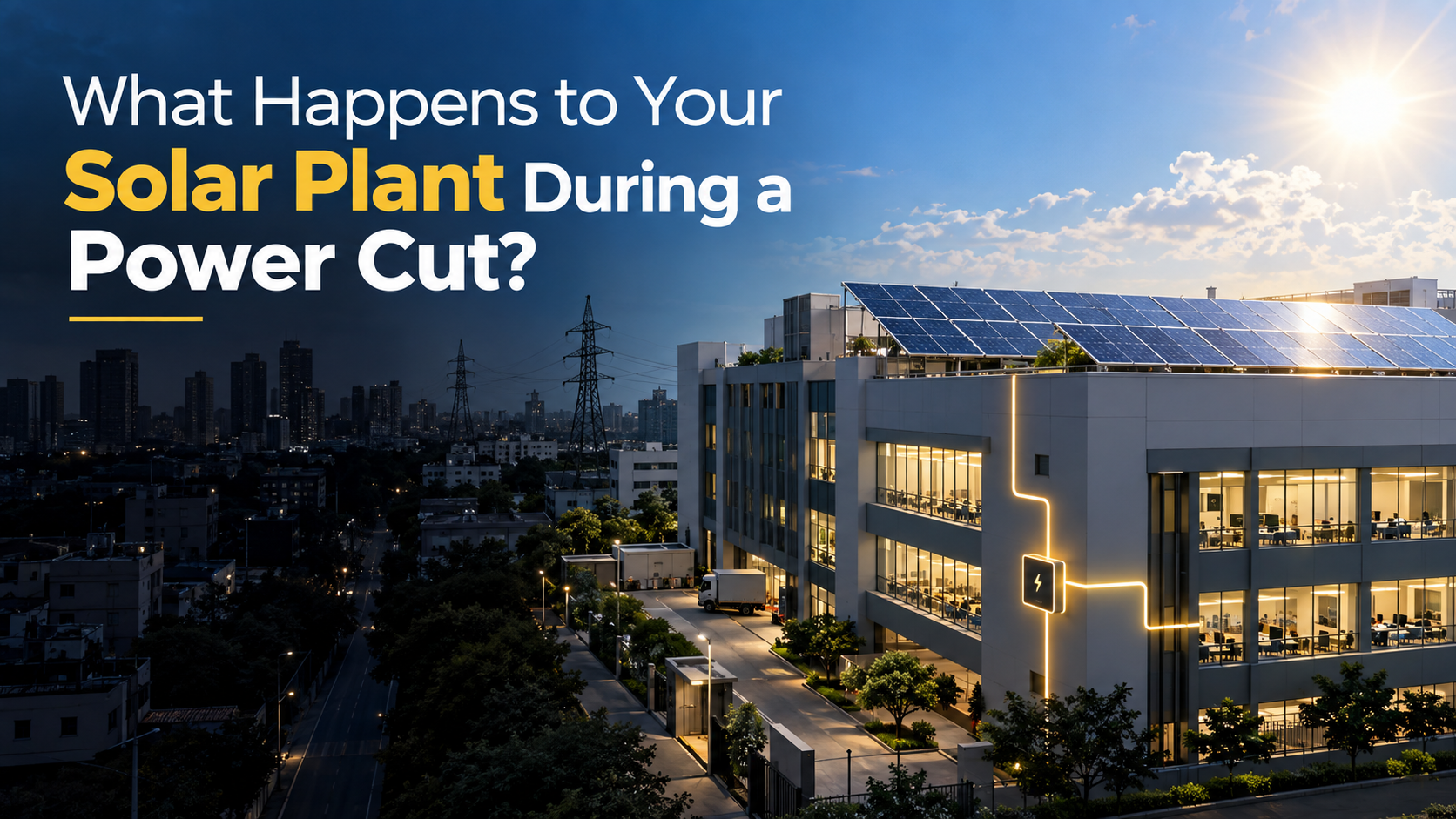
One of the most common questions customers ask before installing solar is:
“If I have solar panels, will I still have power during a power cut?”
The answer depends on the type of solar system you have.
Solar panels may continue receiving sunlight and producing DC electricity, but whether that energy can actually be used during a blackout depends on the inverter, battery storage, system design, and grid connection.
Why Does an On-Grid Solar System Shut Down During a Power Cut?
A standard on-grid solar system works together with the utility electricity grid.
When there is a power failure, the solar inverter automatically shuts down through a safety mechanism called anti-islanding protection.
This is important because electricity from the solar plant should not flow back into utility power lines while technicians are repairing them.
So even on a bright sunny afternoon, a normal on-grid solar plant may stop supplying electricity when the grid goes down.
In simple terms:
Solar panels may still receive sunlight.
The inverter detects that the grid has failed.
The inverter automatically stops operating.
Solar power is temporarily unavailable to the building.
The system starts operating again once grid power returns.
What Happens With a Hybrid Solar System?
A hybrid solar system combines:
Solar panels
Hybrid inverter
Battery storage
Utility grid connection
During normal operation, solar power can supply the building first. Excess energy may be used to charge the batteries or interact with the grid depending on the system configuration.
During a power cut, the hybrid inverter can disconnect from the grid and continue supplying selected electrical loads from solar energy and batteries.
Typical backup loads may include:
Lighting
Computers
Wi-Fi and communication systems
Security systems
Servers
Fans
Essential office equipment
Selected machinery or critical loads
The amount of backup available depends mainly on the battery capacity and power consumption.
What About an Off-Grid Solar System?
An off-grid solar system operates independently from the utility grid.
Solar panels generate electricity during the day, while batteries store excess energy for later use.
These systems are commonly useful in locations where:
Grid electricity is unavailable
Power cuts are frequent
Grid reliability is poor
Remote operations require independent power
An off-grid system can continue operating during a grid outage because it does not depend on the utility network.
However, the battery bank and solar capacity must be correctly designed to meet the expected electrical load.
On-Grid vs Hybrid vs Off-Grid Solar
Feature | On-Grid Solar | Hybrid Solar | Off-Grid Solar |
Connected to utility grid | Yes | Yes | No |
Battery storage | Usually No | Yes | Yes |
Works during normal grid supply | Yes | Yes | Yes |
Works during a power cut | Usually No | Yes | Yes |
Backup power available | No | Yes | Yes |
Primary purpose | Electricity savings | Savings + backup | Energy independence |
Best suited for | Homes, offices, factories with reliable grid | Properties needing backup | Remote or unreliable-grid locations |
Why Doesn't Solar Automatically Give Backup Power?
This is one of the biggest misunderstandings about solar.
Installing solar panels does not automatically mean your building becomes independent from the electricity grid.
A complete backup system requires more than just panels.
It may require:
A compatible inverter
Battery storage
Backup-load planning
Electrical protection systems
Proper system configuration
Automatic switching or backup controls
Without these components, a standard on-grid system cannot normally provide electricity during a blackout.
How Long Can Solar Battery Backup Last?
There is no single answer because backup duration depends on several factors.
Battery backup depends on:
Battery capacity
Number of appliances operating
Power consumption of each appliance
Available solar generation
Battery state of charge
Type of battery
Inverter efficiency
Backup load selected
For example, running only lights, fans, and computers requires much less energy than operating heavy industrial machinery.
This is why businesses should identify their critical loads before choosing battery capacity.
Should Businesses Choose Battery Backup?
Not every business needs battery storage.
For many commercial and industrial customers, the main goal of solar is reducing electricity costs during daytime operations.
In such cases, an on-grid system can be a cost-effective solution.
However, businesses where even a short power interruption can cause operational problems may consider hybrid systems.
Battery backup may be useful for:
Hospitals
Data centres
Offices
Retail stores
Hotels
Communication facilities
Security systems
Critical production equipment
Businesses experiencing frequent outages
Can an Entire Factory Run on Solar During a Power Cut?
Technically it is possible, but the system must be specially designed for it.
Large industrial loads require significant power.
Providing full backup to an entire factory may require:
Large battery banks
High-capacity hybrid inverters
Advanced energy-management systems
Detailed load analysis
Backup prioritisation
Proper electrical integration
For many factories, a more practical approach is to provide backup only for critical loads instead of the complete facility.
This can reduce battery investment while maintaining essential operations during outages.
What Should You Decide Before Installing Solar?
Before selecting your solar system, ask these important questions:
Is my priority mainly electricity-bill savings?
How frequent are power cuts in my location?
Which equipment must continue operating during an outage?
How many hours of backup do I require?
Do I need battery storage now or in the future?
Is my current electrical system suitable for hybrid integration?
Answering these questions helps determine whether an on-grid, hybrid, or off-grid system is the right solution.
Final Thought
Solar panels can generate electricity whenever sufficient sunlight is available, but that does not automatically mean your property will have power during a blackout.
A normal on-grid solar system usually shuts down during a grid failure for safety reasons. A properly designed hybrid or off-grid system, however, can continue supplying electricity using solar generation and battery storage.
The right choice depends on your electricity consumption, backup requirements, grid reliability, and budget.
A well-designed solar system should not only reduce electricity costs — it should also match the way your home or business actually uses energy.