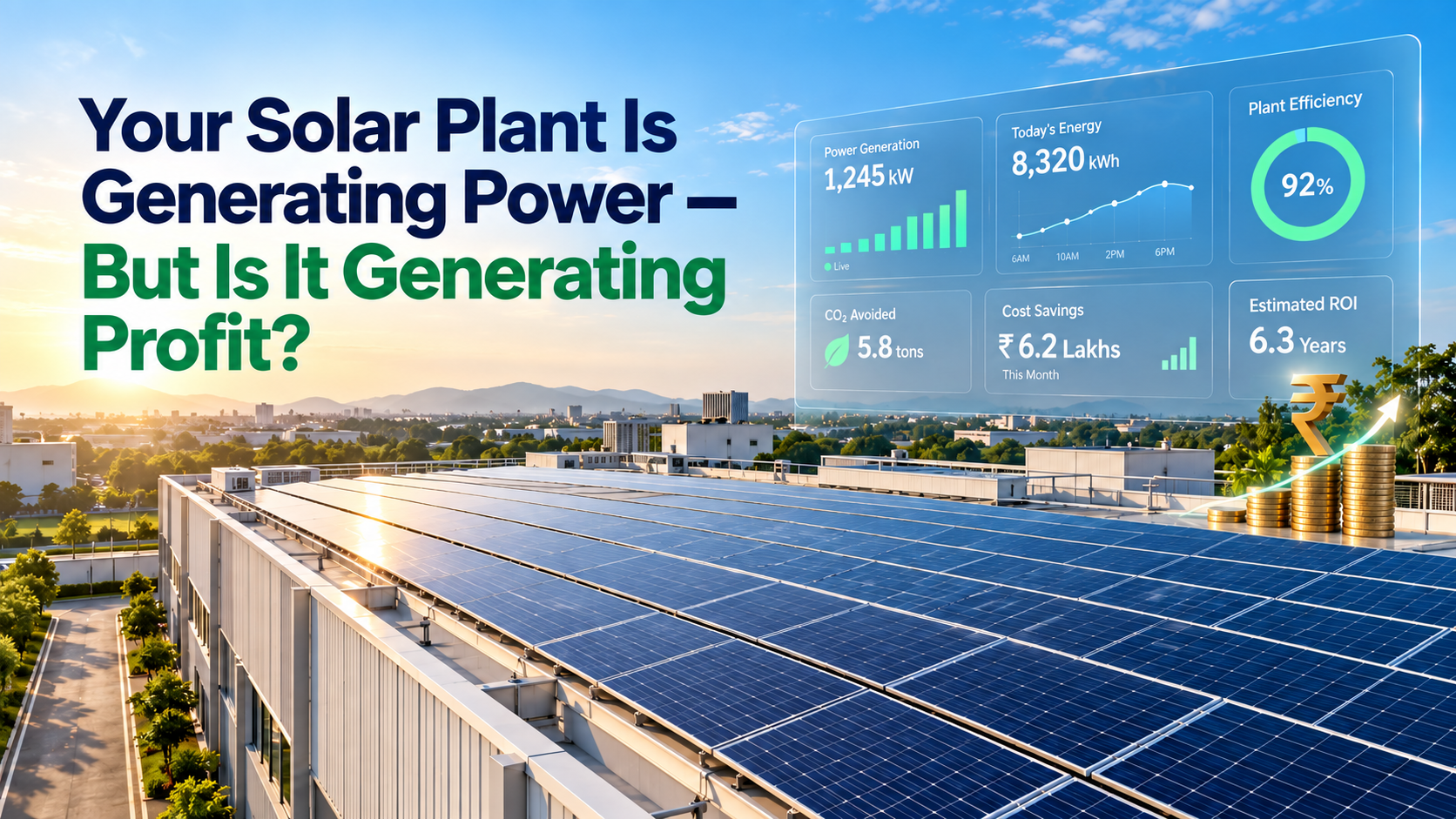
Installing solar is a smart way for businesses to reduce electricity costs and improve long-term energy efficiency. But after installation, one important question should always be asked:
Is your solar plant only generating electricity, or is it delivering the savings and return you expected?
A solar plant may look like it is working perfectly. The inverter may be ON, the panels may appear clean, and daily generation may be visible on the monitoring dashboard. Yet the system can still lose valuable energy because of dust, shading, inverter inefficiency, electrical faults, downtime, or poor maintenance.
This is why solar performance should not be measured only by units generated. It should also be measured by efficiency, savings, downtime, and return on investment.
Generating Power Is Only Half the Story
Two solar plants with the same capacity can produce very different results.
One may perform well because the panels are clean, the inverter is efficient, faults are identified quickly, and the system is regularly maintained.
Another plant of the same size may slowly lose generation because of dust, wiring issues, shading, inverter trips, or unnoticed system faults.
Both plants may technically be “working,” but financially, their performance can be very different.
For this reason, solar should be treated as a long-term business asset, not as a system that can simply be installed and forgotten.
Where Does Solar Performance Get Lost?
Several factors can reduce the output of a solar plant.
Dust and Dirt
Dust, bird droppings, pollution, and industrial particles can block sunlight from reaching the solar cells. Regular cleaning helps maintain better generation, especially in dusty and industrial areas.
Inverter Problems
The inverter converts solar power into usable electricity. Overheating, faults, shutdowns, and efficiency issues can reduce the output of the entire solar system.
Shading
Trees, nearby buildings, water tanks, or new structures can create partial shading. Even small shaded areas can affect overall system performance.
Electrical Issues
Loose connections, damaged cables, faulty connectors, and other electrical problems can reduce efficiency and may also create safety concerns.
Unexpected Downtime
Every hour that a solar plant remains offline during sunlight hours means lost generation and lost savings. Remote monitoring and quick fault detection can help reduce downtime.
Small Losses Can Become Big Financial Losses
A small reduction in daily generation may not look serious.
But when that reduction continues for months or years, it can have a major financial impact.
For example, if a commercial solar plant consistently produces even a few percent less than expected, the total loss over the plant’s lifetime can become significant.
The biggest challenge is that many losses happen gradually.
The system may still generate electricity every day, so the performance drop can remain unnoticed unless the data is regularly reviewed.
What Should Businesses Monitor?
Businesses should look beyond total generation and monitor key performance indicators such as:
Daily and monthly energy generation
Electricity cost savings
Inverter availability
System downtime
Performance ratio
Fault and alarm history
Cleaning and maintenance records
Actual generation compared with expected generation
These indicators provide a clearer picture of whether the solar system is performing efficiently.
Why Solar Monitoring Matters
Modern solar systems provide large amounts of performance data.
But monitoring is useful only when the data is reviewed and acted upon.
For example, if a system usually generates 2,000 units per day but suddenly drops to 1,600 units under similar conditions, there may be a problem.
The cause could be dirty panels, inverter downtime, shading, string failure, or an electrical issue.
Identifying the problem early helps reduce the amount of lost generation.
Preventive Maintenance Protects Your ROI
Solar plants are built for long-term operation, but they still require proper maintenance.
Preventive maintenance can help identify small issues before they become larger and more expensive problems.
Regular inspection of panels, inverters, electrical connections, wiring, structures, and monitoring systems can help:
Reduce downtime
Improve generation
Increase equipment reliability
Maintain safety
Protect long-term savings
Improve return on investment
Measure Solar Performance in Rupees Too
Businesses invest in solar mainly to reduce electricity expenses.
That means every unit of solar electricity has financial value.
Instead of asking only:
“How many units did our solar plant generate?”
Businesses should also ask:
“How much money did the plant save?”
Other important questions include:
Is the plant generating close to its expected output?
How much generation was lost due to downtime?
Are repeated faults affecting performance?
Is the solar plant still meeting its expected ROI?
Connecting technical performance with financial performance provides a better understanding of the true value of the solar investment.
Final Thought
A solar plant that generates electricity is good.
A solar plant that consistently operates near its maximum potential is better.
Regular monitoring, cleaning, preventive maintenance, and timely repairs can help ensure that the system continues delivering strong performance and long-term savings.
So, instead of asking only:
“Is my solar plant working?”
Ask:
“Is my solar plant working at its best?”
Because generating electricity is only half the story.
Maximizing performance and savings is what truly protects your solar investment.