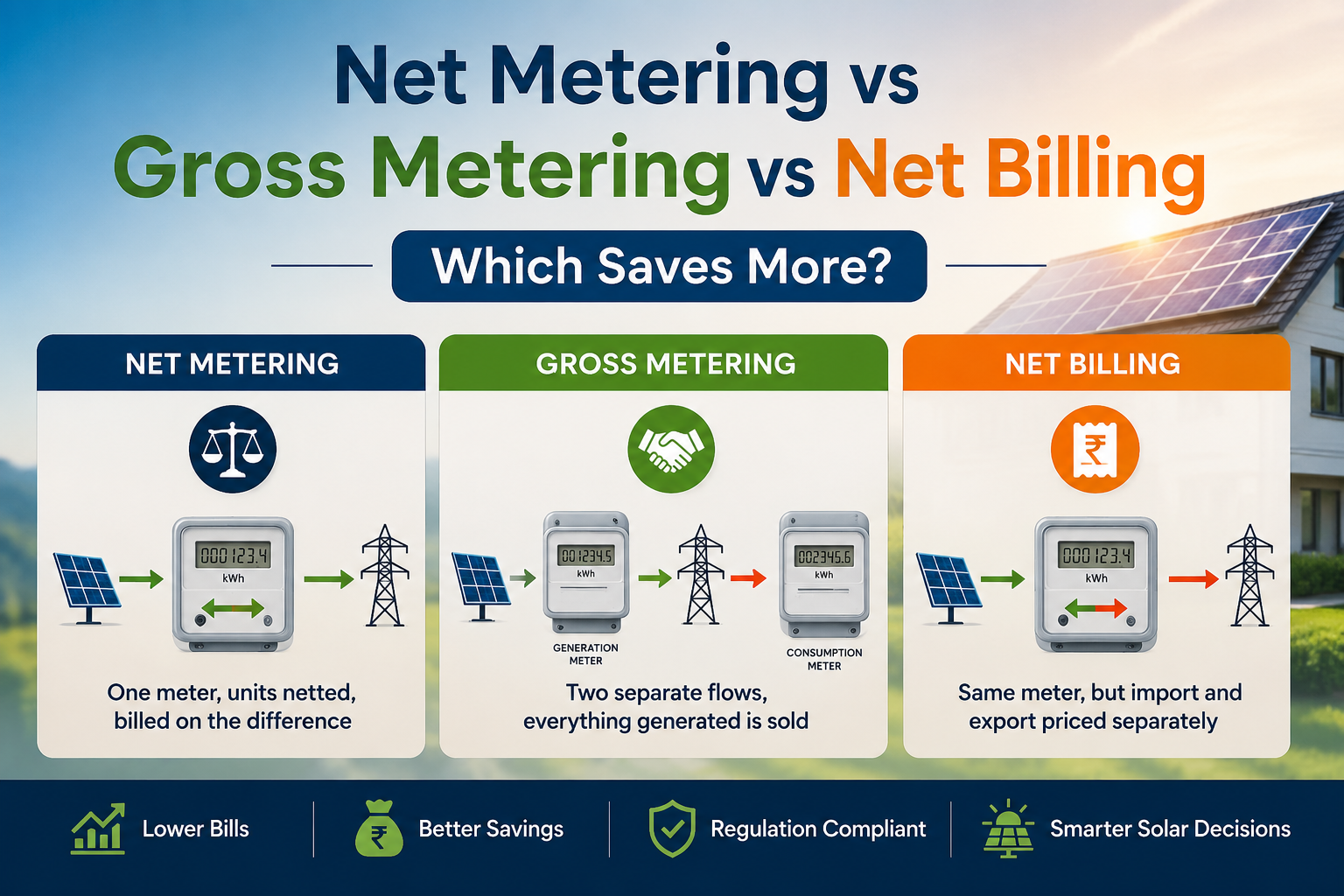
Net Metering vs Gross Metering vs Net Billing : Which Saves More?
Installing solar panels doesn't automatically zero out your electricity bill. What actually lands on your bill depends on which of these three billing systems your distribution company applies to your connection.
This guide breaks down with a full comparison between the three systems with specific rules for Tamil Nadu and for rest of India.
Net Metering | Gross Metering | Net Billing |
|---|---|---|
One meter, units netted, billed on the difference | Two separate flows, everything generated is sold | Same meter, but import and export priced seperately |
If you mostly want to reduce electricity bill, net metering is mostly the best deal, because it credits your exported units a the same rate, you'd otherwise pay to buy them. Gross metering is built for someone who wants to sell every unit they generated for a fixed, guaranteed payment, like a mini power purchase contract on your roof. Net billing sits between, but surplus you send out is paid at a separate, usually lower, rate instead of being credited unit-for-unit,
Frequently used terms
1. DISCOM
Your local electricity distribution company - TANGCO in Tamil Nadu, and the equivalent state utility elsewhere (eg. BESCOM, MSEDCL, BSES).
2. SERC / TNERC
The state regulator that sets the rules and tariffs. Tamil Nadu's is the Tamil Nadu Electricity Regulatory Commission (TNERC).
3. Retail Tariff
The normal per-unit rate you pay the DISCOM for electricity you consume.
4. Feed-in tariff / buyback rate
The (usually lower) per-unit rate the DISCOM pays you for solar power you export to the grid
5. Bidirectional Meter
A meter that records electricity flowing both in your home (import) and out to the grid (export) - required for net metering and net billing.
Why your meter decides your savings, not your panels
Most rooftop solar installations in India are grid-tied rather than battery backed. That single fact matters more than people expect; without a battery, any solar power you don't use the instant it's generated has to go be sent somewhere and this power is sent to the grid. Whether you're paid fairly for that exported power, paid less than it's worth or simply have it treated as a separate sale altogether depends entirely on the billing mechanism your DISCOM applies to your connection.
Across India today, there are three such mechanisms in active use: net metering, gross metering and increasingly common middle path, net billing. Which one you get depends on your state's regulations, your system's capacity and sometimes your consumer category(residential, commercial or industrial).
Net Metering: The unit for unit offset
Net metering is the simplest idea of the three: your solar system feeds your home first. Whatever you don't use immediately during sunlight hours is exported to the grid, and whenever your demand exceeds what your panels are producing at night on a cloudy day or simply at a time of heavy use you draw the shortfall back from the grid.
A single bi-directional meter sits at the point your home connects the the grid and tracks only two numbers over the billing cycle: total units imported and total units exported. At the end of the cycle., the DISCOM nets the two off against the other
Units billed = Units imported from the grid - Units exported to the grid
You're billed at the normal retail tariff, but only on that net figure. The electricity you generated and used yourself never even shows up on the meter — it's effectively free the moment it's produced, which is the whole reason net metering tends to deliver the strongest savings of the three models.
Worked Example
To compare all three systems fairly, we'll use one consistent household across all this entire guide: a home with a rooftop solar system generating 300 units a month. Of that, 150 units are used instantly as they're generated and 150 units are exported as surplus during the day. The home separately draws 250 units from the grid at other times, for a total monthly electricity need of 400 units. We'll use an illustrative retail tariff of ₹7/unit and a feed-in/buyback rate of ₹3/unit figures broadly in line with mid-range Indian residential tariffs and typical solar buyback rates, through your own numbers will differ by state and slab.
Net Metering | Bill Readout |
|---|---|
Grid import ( 250 x ₹7 ) | ₹1,750 |
Grid export ( 150 units x ₹7 ) | -₹1,050 |
Net units billed: 100 * ₹7 | ₹700 |
Bill without solar ( 400 units * ₹7 ) | ₹2,800 |
Advantages
1. Highest savings of the three models, since exports offset consumption at the full retail rate.
2. Only one meter to install and maintain
3. Shorter payback period on your solar investment.
4.No battery required to capture value from daytime surplus.
Limitations
1. Capacity is usually capped based on sanction load
2. Compensation policy for any leftover, unused export credits varies by state and isn't always 1:1.
3. Requires a bidirectional meter, installed and billed for separately by the DISCOM.
Gross Metering: Sell Everything you Generate
Gross metering works completely differently. Instead of feeding your home first, every single unit your solar panels generate is routed straight to the grid through a one way export meter. You never directly consume your own solar power. Your home continues to draw 100% of it's electricity needs from the grid through your existing meter, billed at the normal retail tariff, exactly as if you had no solar system at all.
In return, the DISCOM pays you a fixed feed-in tariff for every unit your system exports, completely independent of how much electricity your home actually used. The two transactions, buying and selling are tracked and billed entirely separately:
Net Bill = (Total consumption x Retail tariff) - (Total solar generation x feed-in tariff)
Because all of your generation is sold rather than self consumed, gross metering structurally needs your full household consumption to be repurchased to be repurchased from grid which is exactly why it tends to deliver the lowest savings of the three models for a typical home, even through it guarantees a predictable income for every unit produced.
Worked Example
Using the same household: 300 units generated and exported in full this time(since none is self-consumed) and the home's full 400 unit need now drawn entirely from the grid.
Gross Metering | Bill Readout |
|---|---|
Full consumption from grid ( 400 units x ₹7 ) | ₹2,800 |
Feed-in payment ( 300 units x ₹3 ) | -₹900 |
Net bill payable | ₹1,900 |
Bill without solar ( 400 units x ₹7) | ₹2,800 |
Monthly saving | ₹900 (32%) |
Advantages
1. Guaranteed, predictable income for every unit generated, regardless of your own consumption
2. Well suited to large rooftops, institutions or private developers monetising idle roof space rather than offsetting bills
3. Simpler revenue model to forecast over the life of the system
Disadvantages
1. No direct reduction in your own electricity bill - you keep paying full retail for everything you consume.
2. Feed-in tariffs are typically well below the retail tariff. so the per unit value you receive is lower
3. Often subject to a minimum system size before a DISCOM will offer this route.
Net Billing : Self-Consumption plus a separate export rate
Net billing is the hybrid that many DICOMSs have begun introducing as rooftop solar scales up. It looks similar to net metering on the surface, since you still consume your own solar power directly during the day and only the surplus is exported. The difference is purely financial instead of netting difference at the retail tariff, net billing keeps the two flows financially separate.
Net bill = (Units imported × retail tariff) − (Units exported × feed-in/buyback tariff)
You're billed in full for whatever you draw from the grid, and separately credited at the lower feed-in rate for whatever you send back. The self-consumed portion is still effectively free, which is why net billing comfortably beats gross metering — but because the exported units are no longer worth the full retail rate, it doesn't quite match the savings of true net metering either.
Worked Example
Same household again: 150 units self-consumed (free, as with net metering), 150 units exported and credited at the lower feed-in rate, 250 units imported and billed in full.
Net Billing | Bill Readout |
|---|---|
Grid import billed in full ( 250 units * ₹7) | ₹1,750 |
Export Credit ( 150 units x ₹3, feed in rate) | -₹450 |
Net bill payable | ₹1,300 |
Bill without solar ( 400 units x ₹7) | ₹2,800 |
Monthly savings | ₹1,500 (54%) |
Advantages
1. You still get the full value of self-consumed solar power, the largest single driver of savings.
2. Earns a separate income stream for whatever surplus you export, even if it's at a lower rate.
3. Often the fallback option when regulators cap or phase down full net metering at scale.
Limitations
Lower overall savings than net metering, since exported units are no longer credited at the retail rate.
Export and import tariffs both vary by DISCOM and by year, so the gap between the two rates can widen or narrow.
Still policy-dependent — terms can change as a state's solar capacity grows.
Net Metering vs Gross Metering vs Net Billing: Full Comparison
NET METERING | GROSS METERING | NET BILLING |
|---|---|---|
Net of import and export, in one figure | Two separate, one-way flows | Import and export recorded together, billed apart |
Bidirectional | Uni-directional export meter + existing consumption meter | Bidirectional |
Yes, used first, effectively free | No, all generation is exported | Yes, used first, effectively free |
Same as retail tariff (1:1) | Fixed feed-in tariff | Fixed feed-in tariff, usually lower than retail |
Fixed feed-in tariff, usually lower than retail | Fixed feed-in tariff, usually lower than retail | Self-consumers in states phasing out full net metering |
₹700 | ₹1,900 | ₹1,300 |
₹2,100 (75%) | ₹900 (32%) | ₹1,500 (54%) |
Available to most residential/commercial connections up to a capacity cap | Often needs a minimum capacity; common for commercial rooftops | Increasingly used above certain capacity thresholds or in select states |
Which one is actually right for you
A Homeowner with daytime + evening usage | Net metering, wherever your DISCOM still offers it for your system size |
An apartment / RWA with a shared terrace system | Aggregated net metering, where available, split across flats |
A shop or small business with a roof you'd rather monetise than power your own load | Gross metering, if your DISCOM permits it at your capacity |
A consumer in a state where net metering is capped or being phased down | Net billing, as the next-best self-consumption option |
A larger industrial or commercial consumer evaluating open access | A separate conversation with your DISCOM on wheeling, banking and PPA routes — outside the scope of typical residential billing |
Frequently Asked Questions
1. Which is better: net metering or gross metering?
For most homes and small businesses, net metering gives far higher savings because it offsets your own consumption unit-for-unit at the retail tariff. Gross metering only makes sense if your goal is to sell 100% of your solar output for a fixed, guaranteed payment, rather than reduce your own electricity bill.
2. What is net billing, in plain terms?
Net billing also lets you use your own solar power first, exactly like net metering. The difference is in how the leftover export is paid: net metering nets the units together and bills you at the retail tariff on the difference, while net billing bills your full grid import at the retail tariff and separately pays you a lower feed-in rate for whatever you exported.
3. Is net metering available across all of Tamil Nadu?
Yes. TANGEDCO has offered net metering for rooftop solar since around 2012, and it remains the default route for residential, commercial and most institutional rooftop solar connections across the state, subject to TNERC's regulations and a feasibility check on your local transformer.
4. What's the maximum solar capacity allowed under net metering in Tamil Nadu?
TANGEDCO generally permits net metering for rooftop solar capacity up to 1 MW per consumer connection, provided the system size doesn't exceed your sanctioned load and there's adequate headroom on the local distribution transformer.
5. Do unused solar export credits expire in Tamil Nadu?
Surplus export credits are carried forward across billing cycles rather than lost immediately. At the annual settlement, any credits still unused are typically paid out at the applicable buyback or feed-in rate, which is lower than the retail tariff — so it's generally more valuable to size your system close to your own consumption than to deliberately over-generate.
6. Can apartment owners in Chennai or Coimbatore get net metering for a shared rooftop?
Yes. TNERC's updated prosumer regulations include provisions for aggregated net metering for housing society and apartment rooftops, allowing the solar power generated on a shared terrace to be apportioned across multiple flats or units on a shared connection.
7. Will my net metering connection get downgraded to gross metering or net billing later?
It can, in some states, if your system size grows beyond the capacity threshold your state regulator has set for full net metering, or if your state revises its policy as overall rooftop solar capacity scales up. This is exactly why it's worth checking your state's current capacity caps before expanding an existing system.
What's the actual difference between the feed-in tariff and the retail tariff?
The retail tariff is what you pay your DISCOM to buy electricity. The feed-in tariff (also called the buyback rate) is what your DISCOM pays you for solar electricity you export. The feed-in tariff is almost always lower than the retail tariff, which is exactly why net metering, where exports offset consumption at the retail rate, tends to save consumers more than gross metering or net billing, where exports are valued at the lower feed-in rate.