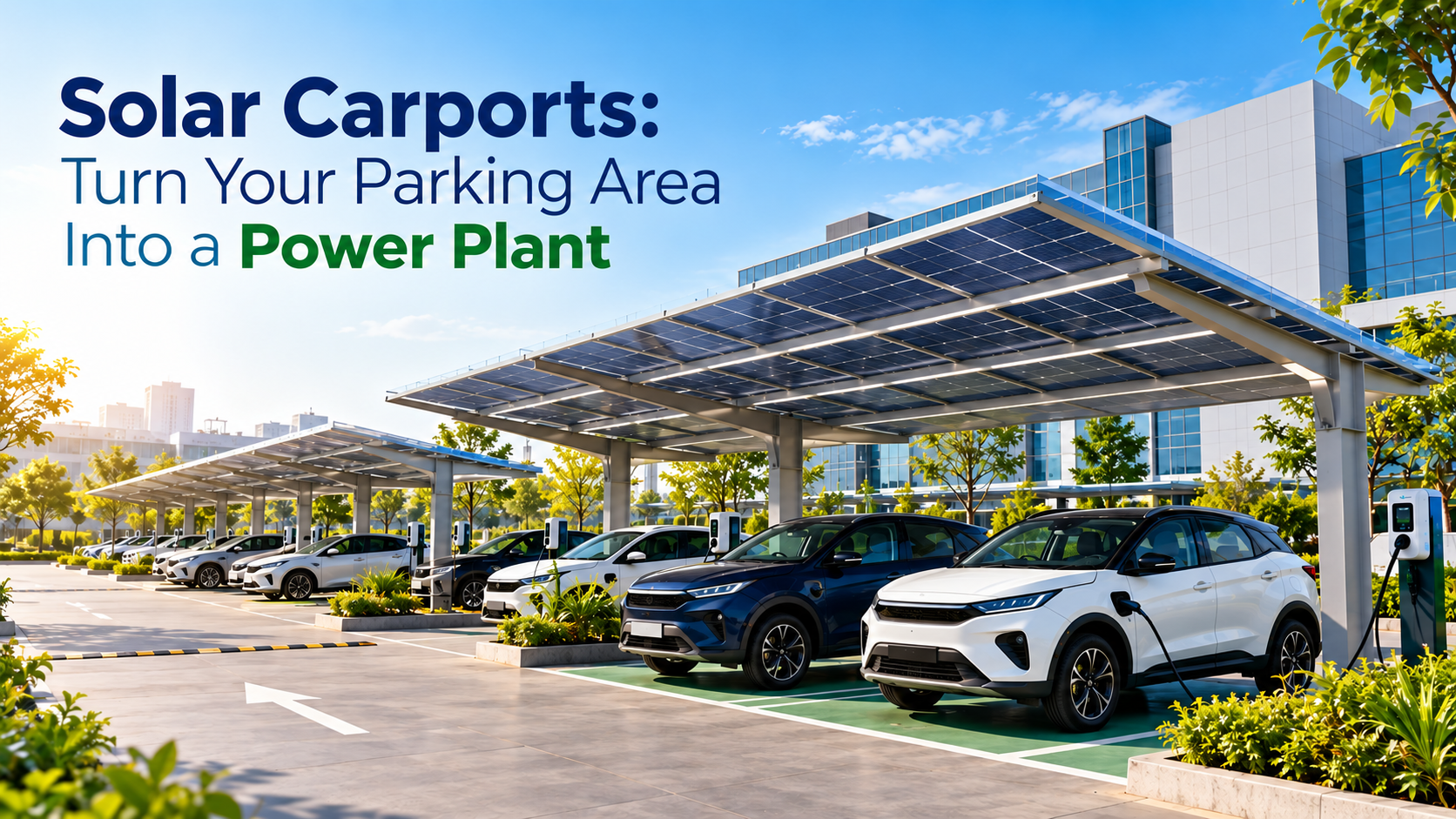
Parking areas are usually seen as spaces meant only for vehicles. But with the growing demand for clean energy and smarter use of available space, businesses can now transform parking areas into valuable energy-generating assets.
A solar carport is a structure built over a parking area with solar panels installed on top. It provides shade for parked vehicles while simultaneously generating electricity from sunlight.
Instead of using additional land or depending only on rooftop space, solar carports allow businesses, institutions and commercial properties to make better use of areas they already have.
What Is a Solar Carport?
A solar carport is similar to a normal covered parking structure, but instead of a conventional roof, the structure supports solar photovoltaic panels.
These solar panels capture sunlight and convert it into electricity that can be used within the building or facility.
Solar carports can be installed in places such as:
Factories and industrial facilities
Corporate offices
Hospitals
Shopping malls
Schools and colleges
Hotels and resorts
Apartment complexes
Commercial buildings
Airports
Warehouses
EV charging stations
For businesses with large open parking areas, solar carports can provide a practical way to increase solar generation capacity without occupying additional land.
Why Are Solar Carports Becoming Popular?
Businesses are increasingly looking for ways to reduce electricity costs while making better use of their existing infrastructure.
Traditional rooftop solar installations remain one of the most effective options. However, some buildings may have limited rooftop space because of equipment, water tanks, ventilation systems, structural restrictions or future expansion plans.
In such situations, parking areas can provide valuable additional space for solar installation.
A solar carport allows businesses to generate clean electricity while continuing to use the same area for parking.
In simple terms, the same space performs two functions:
Parking + Power Generation
This makes solar carports particularly attractive for commercial and industrial facilities with large parking areas.
1. Generate Electricity From an Existing Space
One of the biggest advantages of solar carports is that they use space that already exists.
A conventional parking area normally generates no direct financial benefit. By installing solar panels above it, the same area can start producing electricity every day.
The electricity generated can help power:
Office buildings
Factory equipment
Lighting systems
Air-conditioning
Machinery
Pumps
Security systems
Common-area electrical loads
EV charging stations
Depending on the system capacity and electricity consumption pattern, this can reduce the amount of electricity purchased from the grid.
2. Reduce Electricity Bills
Commercial and industrial facilities often have significant daytime electricity consumption.
Solar generation is especially useful because most electricity is produced during daylight hours, which often matches the operating hours of businesses, factories, schools and commercial properties.
When electricity generated by the solar carport is consumed directly within the facility, the business can reduce its dependence on grid electricity.
Over the long term, this can contribute to substantial electricity cost savings.
The actual savings depend on several factors, including:
Solar system capacity
Local solar irradiation
Electricity tariff
Daily electricity consumption
System design
Panel orientation
Shading conditions
Maintenance quality
A properly designed solar carport can therefore become a long-term energy-saving investment.
3. Protect Vehicles From Sun and Rain
Solar carports provide another important benefit beyond electricity generation: vehicle protection.
Vehicles parked in open areas are exposed to direct sunlight, heat, rain and changing weather conditions.
A solar carport provides shade above parking spaces, helping reduce direct sunlight on vehicles.
This can make parked vehicles more comfortable, especially in hot climates where vehicle interiors can become extremely warm.
The structure can also provide partial protection from rain and other weather conditions.
For employees, customers and visitors, shaded parking can improve the overall experience of the facility.
4. Ideal for EV Charging Infrastructure
Electric vehicles are becoming increasingly common, and businesses are beginning to install EV charging stations for employees, customers and fleet vehicles.
Solar carports are naturally suited for EV charging.
Solar panels generate electricity above the parking spaces while EV chargers can be installed nearby.
This creates an integrated energy solution where vehicles can potentially be charged using electricity generated from sunlight.
A solar carport with EV charging can be particularly useful for:
Corporate offices
Shopping malls
Hotels
Hospitals
Universities
Apartment communities
Commercial parking facilities
Fleet operators
As EV adoption grows, combining solar generation with charging infrastructure can help businesses prepare for future transportation needs.
5. Make Better Use of Limited Rooftop Space
Not every building has enough rooftop space for a large solar system.
Some rooftops may already contain:
HVAC systems
Water tanks
Communication equipment
Ventilation units
Walkways
Other utilities
In such situations, parking areas can provide an additional location for solar panels.
Businesses can even combine rooftop solar and solar carports to increase their total solar capacity.
For example, a factory could install solar panels on the roof and use the employee parking area for an additional solar carport system.
This allows the facility to maximise solar generation from the available property.
6. Suitable for Commercial and Industrial Facilities
Solar carports are particularly useful for facilities with large parking areas.
Factories and industrial sites often have significant electricity consumption during daytime operating hours.
A solar carport installed above employee or visitor parking can generate electricity that supports factory operations.
Similarly, shopping malls and commercial centres usually have large parking areas that receive strong sunlight throughout the day.
Installing solar carports can help these facilities make better use of their property while supporting their electricity requirements.
7. Improve the Appearance of the Facility
A professionally designed solar carport can also improve the visual appearance of a property.
Modern solar carport structures can be designed with clean lines, strong structural support and organised parking layouts.
For corporate campuses, malls, hotels and institutions, solar carports can create a modern and environmentally responsible image.
Visitors immediately see the solar installation when they enter the property, making the company's renewable-energy initiative highly visible.
8. Support Sustainability Goals
Many organisations are setting sustainability and renewable-energy targets.
Installing solar carports can help businesses increase the amount of renewable electricity used within their facilities.
Reducing dependence on conventional grid electricity can contribute to lower carbon emissions associated with electricity consumption.
Solar carports can therefore become part of a broader sustainability strategy alongside:
Rooftop solar systems
Energy-efficient equipment
LED lighting
Energy monitoring
EV adoption
Battery energy storage
Green building initiatives
For companies reporting environmental or ESG-related initiatives, visible solar infrastructure can also demonstrate their commitment to renewable energy.
9. Solar Carports Can Be Designed for Different Parking Areas
Solar carports are not limited to one standard design.
The structure can be customised depending on the available area, parking layout and number of vehicles.
Common solar carport configurations include:
Single-Row Solar Carport
Designed to cover a single row of parked vehicles.
This type can be suitable for smaller commercial properties and office parking areas.
Double-Row Solar Carport
A larger structure covering vehicles parked on both sides.
This design can support more solar panels and generate more electricity.
Large Commercial Solar Carport
Designed for malls, factories, hospitals and large institutions with extensive parking areas.
These systems can potentially support significant solar capacity.
The structure, column placement, height and panel angle must be carefully engineered according to site conditions.
10. Solar Carports Require Proper Engineering
A solar carport is not simply a set of solar panels installed above vehicles.
The structure must be carefully designed to safely support the solar modules and withstand environmental conditions.
Engineering considerations may include:
Wind loads
Structural strength
Foundation design
Column placement
Panel mounting
Drainage
Vehicle clearance
Electrical cable routing
Earthing
Safety systems
Maintenance access
Professional engineering is important because the structure must remain safe while supporting the solar system for many years.
How Much Solar Can a Parking Area Support?
The capacity of a solar carport depends primarily on the size and layout of the parking area.
Larger parking areas can accommodate more solar panels and therefore support greater generation capacity.
During a site assessment, solar engineers normally evaluate:
Number of parking spaces
Available area
Orientation of the site
Surrounding buildings
Potential shading
Electrical infrastructure
Electricity consumption
Structural requirements
Based on these factors, the appropriate solar capacity can be calculated.
Will Solar Carports Work During Cloudy Weather?
Yes.
Solar panels can still generate electricity when sunlight is diffused through clouds, although generation will normally be lower than during clear sunny conditions.
The actual output depends on weather conditions, system design and the intensity of available sunlight.
Solar generation therefore varies throughout the day and across different seasons.
How Long Can a Solar Carport System Operate?
High-quality solar panels are designed for long operating lifetimes.
With proper installation, regular inspection and maintenance, a solar carport system can continue generating electricity for many years.
Regular maintenance typically includes:
Solar panel cleaning
Electrical inspections
Structural inspections
Inverter monitoring
Cable checks
Performance monitoring
Monitoring the solar system also helps identify any unexpected drop in electricity generation.
Solar Carport vs Rooftop Solar
Both options can be effective, and the right solution depends on the property.
Rooftop Solar | Solar Carport |
Uses available rooftop space | Uses parking areas |
Does not require a separate parking structure | Requires a dedicated support structure |
Suitable for many residential and commercial buildings | Particularly useful for commercial and industrial properties |
Generates electricity from unused roof space | Generates electricity while providing vehicle shade |
Can be combined with battery storage | Can be combined with EV charging |
In many projects, the most effective solution may be a combination of both rooftop solar and solar carports.
Solar Carports and Battery Storage
Solar carports can also be integrated with battery energy storage systems.
During periods of high solar generation, excess electricity can potentially be stored in batteries and used later when required.
Battery storage can be useful for businesses seeking greater control over how and when solar electricity is consumed.
However, battery requirements depend heavily on the facility's electricity demand, operating hours and backup requirements.
A detailed energy analysis is therefore important before selecting a battery system.
Is a Solar Carport Right for Your Business?
A solar carport may be worth considering if your property has:
A large open parking area
High daytime electricity consumption
Limited rooftop space
Plans to install EV chargers
A requirement for shaded parking
Renewable-energy or sustainability targets
Before installation, a professional site survey should evaluate whether the property is technically and financially suitable.
Turn Your Parking Area Into an Energy-Producing Asset
Parking areas do not have to remain unused from an energy perspective.
With a properly designed solar carport, businesses can transform existing parking spaces into infrastructure that generates electricity every day.
Instead of choosing between parking space and solar power, a solar carport allows businesses to have both.
Vehicles remain parked underneath while solar panels above capture sunlight and generate clean electricity.
For factories, offices, hospitals, schools, malls and other commercial properties with large parking areas, this can be an effective way to expand renewable-energy capacity.
Ready to Explore Solar Carports for Your Property?
Daystar Solar can help evaluate your available parking area and design a solar solution based on your electricity consumption, site conditions and available space.
From site inspection and engineering to installation, monitoring and maintenance, our team can support your solar project from start to finish.
Contact Daystar Solar
Call: +91 91766 68617 / 32 / 34 / 50 / 51 / 57 / 64
Email: info@daystarsolar.co.in
Website: www.Daystarsolar.co.in
Turn unused space into useful energy with Daystar Solar.