
Solar Panel Installation Cost in Tamil Nadu: Prices, Subsidies & ROI
Tamil Nadu gets roughly 300 sunny days a year. Your electricity bill probably doesn't reflect that — but it can. Here's the honest, numbers-first breakdown of what going solar actually costs in 2026.
If you've been Googling solar costs for Tamil Nadu, you've likely seen wildly different numbers. That's because most articles use national averages that don't account for Tamil Nadu's solar irradiance, TANGEDCO tariff structure, or the real-world subsidies available right now. This guide pulls from current installer pricing, government scheme data, and on-ground experience to give you a clear picture.
Why Tamil Nadu Is One of India's Best States for Solar
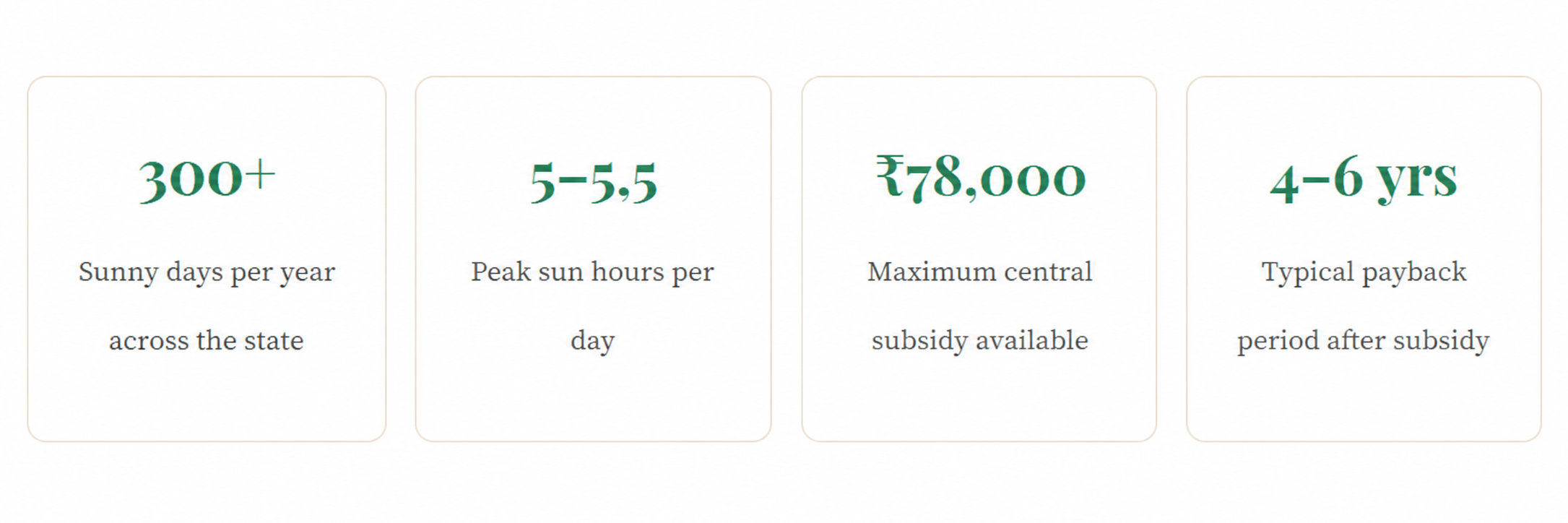
Tamil Nadu has been at the forefront of India's renewable energy push for years — from large-scale wind farms in Tirunelveli to rooftop solar adoption in urban Chennai. The state's combination of high solar irradiance, a relatively high domestic electricity tariff (making savings more meaningful), and an active TANGEDCO net metering program creates one of the strongest cases for rooftop solar in the country.
For homeowners with monthly electricity bills above ₹2,000, the math almost always works out in favour of going solar — especially after the central government subsidy under PM Surya Ghar Muft Bijli Yojana.
Who benefits most: Households consuming 300–600 units/month, families planning to add EVs, and anyone tired of TANGEDCO's rising tariff slabs. A 3–5 kW system covers most middle-class households in Tamil Nadu.
Solar Panel Installation Price In Tamil Nadu
The total solar panel installation cost includes panels, an inverter, mounting structure, wiring, and labour. Solar price varies based on panel technology (Mono PERC vs. TOPCon), inverter brand, and roof type. The table below reflects current market pricing from installers operating in Tamil Nadu:
SYSTEM SIZE | ESTIMATED COST(₹) | APPROX DAILY GENERATION | SUITABLE FOR |
|---|---|---|---|
1KW | 65,000 - 75,000 | 4–5 units/day | 1BHK, minimal usage |
2KW | 1,30,000 - 1,50,000 | 8–10 units/day | Small 2 BHK, ~200 units/month |
3 kW | ₹1,95,000 – ₹2,25,000 | 12–15 units/day | Average household, ~300 units/month |
5 kW (MOST RECOMMENDED) | ₹3,25,000 – ₹3,75,000 | 18–22 units/day | 3–4 BHK, AC + appliances |
10 kW | ₹6,50,000 – ₹7,50,000 | 40–45 units/day | Large home, small business |
Why does per-kW cost drop at higher capacities?
Larger systems share the fixed costs of the inverter, mounting, and installation labour across more panels — so a 5 kW system is significantly cheaper per watt than two separate 2.5 kW systems. If you're on the fence between 3 kW and 5 kW, the economics usually favour going larger.
What affects Price of Installing Solar Panels?
Not all quotes are equal. Here's what drives the variance between ₹65/watt and ₹85/watt pricing you'll see in the market:
Panel Technology
Mono PERC panels are the standard sweet spot. TOPCon panels offer 2–3% higher efficiency but cost 8–12% more, New HJT panels offer efficiency surpassing both making solar energy worth it for roofs with space constraints.
Inverter Brand
String inverters from reputed brands (Growatt, SolarEdge, Sungroww) add cost but improve reliability and remote monitoring. Avoid unknown-brand inverters for long-term installations.
Mounting Structure
Hot dip GI (galvanised iron) structures are adequate; aluminium costs slightly more but lasts longer, especially near the coast
Roof/Surface Type
Flat RCC roofs are cheapest to install on. Sloped tile/sheet roofs may add ₹5,000–15,000 in labour.
If you want one company to own the entire outcome, go with Daystar Solar who maintain an in-house design team and source only from verified distributors — so there's no finger-pointing between vendors if something goes wrong
Solar Rooftop Scheme Subsidies in Tamil Nadu
This is where Tamil Nadu homeowners can significantly reduce their upfront solar panel installation cost. The PM Surya Ghar Muft Bijli Yojana India's flagship solar rooftop scheme offers direct cash subsidies for residential installations.
Central Government Subsidy — PM Surya Ghar Yojana
SYSTEM CAPACITY | SUBSIDY AMOUNT(₹ ) | NOTES |
|---|---|---|
1KW | ₹ 30,000 | Covers ~40–45% of system cost |
2KW | ₹ 60,000 | Covers ~40–45% of system cost |
3KW and Above | ₹ 78,000 (MAXIMUM) | Subsidy is capped; applies to all larger systems |
Key eligibility rules:
The subsidy is only for residential properties, the panels installed should be under DCR category, and the topology installed must be on-grid. It is credited directly to your bank account (not deducted at source). You must use an MNRE-empanelled installer, and the system must be registered on the national portal pmsuryaghar.gov.in.
What about a Tamil Nadu state subsidy?
As of 2026, Tamil Nadu does not offer an additional state subsidy for residential rooftop solar installations beyond the central scheme. However, two groups have access to additional benefits:
Farmers and Agricultural users:
Under the PM-KUSUM Yojana, eligible farmers can receive up to 60% government subsidy on solar irrigation pumps, with financing support available for the remaining cost, significantly reducing the upfront investment
Commercial and Industrial Properties:
can benefit from accelerated depreciation (40% in year one) and input GST credits on the system.
Cost of Installing 1kw, 3kw and 5kw Solar Panels with Subsidy
Here's what you actually pay after the PM Surya Ghar subsidy is credited to your account - the real solar price for Tamil Nadu homeowners:
System Size | Before Subsidy (₹) | Subsidy (₹) | After Subsidy (₹) |
|---|---|---|---|
1 kW | ₹65,000 – ₹75,000 | ₹30,000 | ₹35,000 – ₹45,000 |
2 kW | ₹1,30,000 – ₹1,50,000 | ₹60,000 | ₹70,000 – ₹90,000 |
3 kW | ₹1,95,000 – ₹2,25,000 | ₹78,000 | ₹1,17,000 – ₹1,47,000 |
5 kW | ₹3,25,000 – ₹3,75,000 | ₹78,000 | ₹2,47,000 – ₹2,97,000 |
10 kW | ₹6,50,000 – ₹7,50,000 | ₹78,000 | ₹5,72,000 – ₹6,72,000 |
You typically pay the full amount to the installer upfront. The subsidy amount (₹30,000 / ₹60,000 / ₹78,000) is transferred directly to your bank account by MNRE after inspection and approval — this usually takes 4–8 weeks after installation.
Daystar Solar handles the full process — design, installation, subsidy paperwork, and maintenance — so you're not coordinating between three different contractors.
Payback Period and Return on Investment
The question everyone really wants answered: how long until the system pays for itself?
For a typical 5 kW system in Chennai or Coimbatore, here's a worked example:
FACTOR | VALUE |
|---|---|
System cost (after subsidy) | ~₹2,70,000 |
Annual generation | 7200 - 9000 |
Avoided electricity cost (annually) | ₹34,000 - 51,654 |
Effective payback period | 8 years - 5 years |
System Lifespan | 25 years - 30 years |
That means 17–20 years of essentially free electricity after the payback period, from panels with a 25-year performance warranty. Even accounting for inverter replacement (typically needed once in 10–12 years, at ~₹30,000–50,000), the lifetime return on a 5 kW system is well over ₹10 lakh.
Net Metering with TANGEDCO
Net metering is what makes on-grid solar economically powerful in Tamil Nadu. When your panels produce more electricity than you're consuming (typically midday), the surplus is exported to the grid. TANGEDCO credits this against your consumption when you draw from the grid (typically mornings and evenings).
Available for systems up to 10 kW in Tamil Nadu
Residential exports credited at ₹3/unit
Net metering application is handled alongside the subsidy process — Daystar Solar completely facilitates this
Requires a bi-directional (import/export) meter installed by TANGEDCO at no charge
Settlement is typically monthly — credits carry forward and are settled annually
TANGEDCO's net metering tariff for exports is lower than the retail import tariff, so the most financially optimal approach is to maximise self-consumption (by running high-load appliances — washing machine, AC, water heater — during daytime) and minimise export. A smart home timer or simple habit change can meaningfully improve your ROI.
How to Apply for the Solar Rooftop Scheme Subsidy
Register on the PM Surya Ghar portal - Visit pmsuryaghar.gov.in and create an account using your mobile number and electricity consumer number (from your TANGEDCO bill).
Submit your application - Fill in your property details, roof area, and desired system capacity. Upload your electricity bill, Aadhaar, and bank account details.
Get feasibility approval - TANGEDCO reviews your application and approves the system capacity based on your consumption and grid capacity in your area. This can take 1–3 weeks.
Choose an MNRE installer - The portal shows registered vendors in your area.
5. Installation and inspection - Post installation, upload photos and system details. TANGEDCO conducts a site inspection and installs the net meter.
6. Subsidy disbursement - After approval, the subsidy (₹30,000 / ₹60,000 / ₹78,000) is credited directly to your bank account, typically within 4–8 weeks of approval.
Daystar Solar is an MNRE-empanelled installer with experience across 1kW residential systems to 1MW commercial projects — and an in-house team that handles design, installation, and long-term maintenance
The paperwork can be tedious. Most reputable installers handle the entire subsidy application process as part of their service — ask about this before signing. Choose installers with a track record of successful subsidy disbursements, not just low quotes.
Choosing the Right Solar Panel Installation Size
The most common mistake is either undersizing (missing savings potential) or oversizing (paying for excess capacity that you can't consume or export profitably). Here's a simple framework:
MONTHLY BILL/USAGE | UNITS per Month | Recommended Size |
|---|---|---|
₹3,000 – ₹5,500 | ~350–500 units | 3–5 kW |
₹5,500 – ₹10,000 | ~600–900 units | 5–8 kW |
Above ₹10,000 | 1,000+ units | 8–10+ kW |
On-grid vs. off-grid vs. hybrid
On-grid (grid-tied):
Best for most urban and semi-urban Tamil Nadu homes. No battery needed, maximum subsidy eligibility, net metering credits. The system shuts down during power cuts (a safety requirement).
Hybrid:
Adds battery storage — useful if you have frequent power cuts or want backup. Adds ₹80,000–₹1,50,000 to the cost and reduces subsidy eligibility. Recommended only if your area has daily outages exceeding 2–3 hours.
Off-grid:
For locations without TANGEDCO grid connection. Significantly more expensive due to large battery bank requirements.
Frequently Asked Questions
1. Do I need to own my home to install solar?
Yes, in practice — you need to be the electricity consumer account holder for the property to apply for the subsidy and net metering connection
2. Is solar installation worth it for a ₹1,000/month bill?
Marginally. At very low consumption levels, the payback period stretches to 8–10 years even after subsidy, and you may not qualify for the full ₹78,000 subsidy. Solar becomes clearly worth it when your monthly bill is consistently above ₹2,000. That said, if you anticipate consumption growing (new appliances, EV, expansion), installing now at a 2–3 kW scale can still make sense.
3. Which panel brand should I choose?
For Tamil Nadu's climate, Mono PERC or TOPCon panels from reputed manufacturers (Waaree, Adani Solar, Vikram Solar, Tata Power Solar) are recommended. Avoid panels from unverified brands
4. What is the maintenance cost after solar panel installation?
Solar panels have virtually no moving parts and require minimal maintenance. Cleaning the panels with water and a soft cloth every 2–3 months (more frequently during summer dust season) is sufficient
Daystar Solar includes structured AMC plans as part of their end-to-end service — so maintenance isn't an afterthought you negotiate separately after installation."
5. Can I install solar on an apartment flat?
Yes, though it's more complex. Apartment societies can install rooftop solar on common areas and distribute savings across flats this falls under group net metering or collective solar schemes. Individual flat owners in high-rises typically cannot install dedicated rooftop systems.