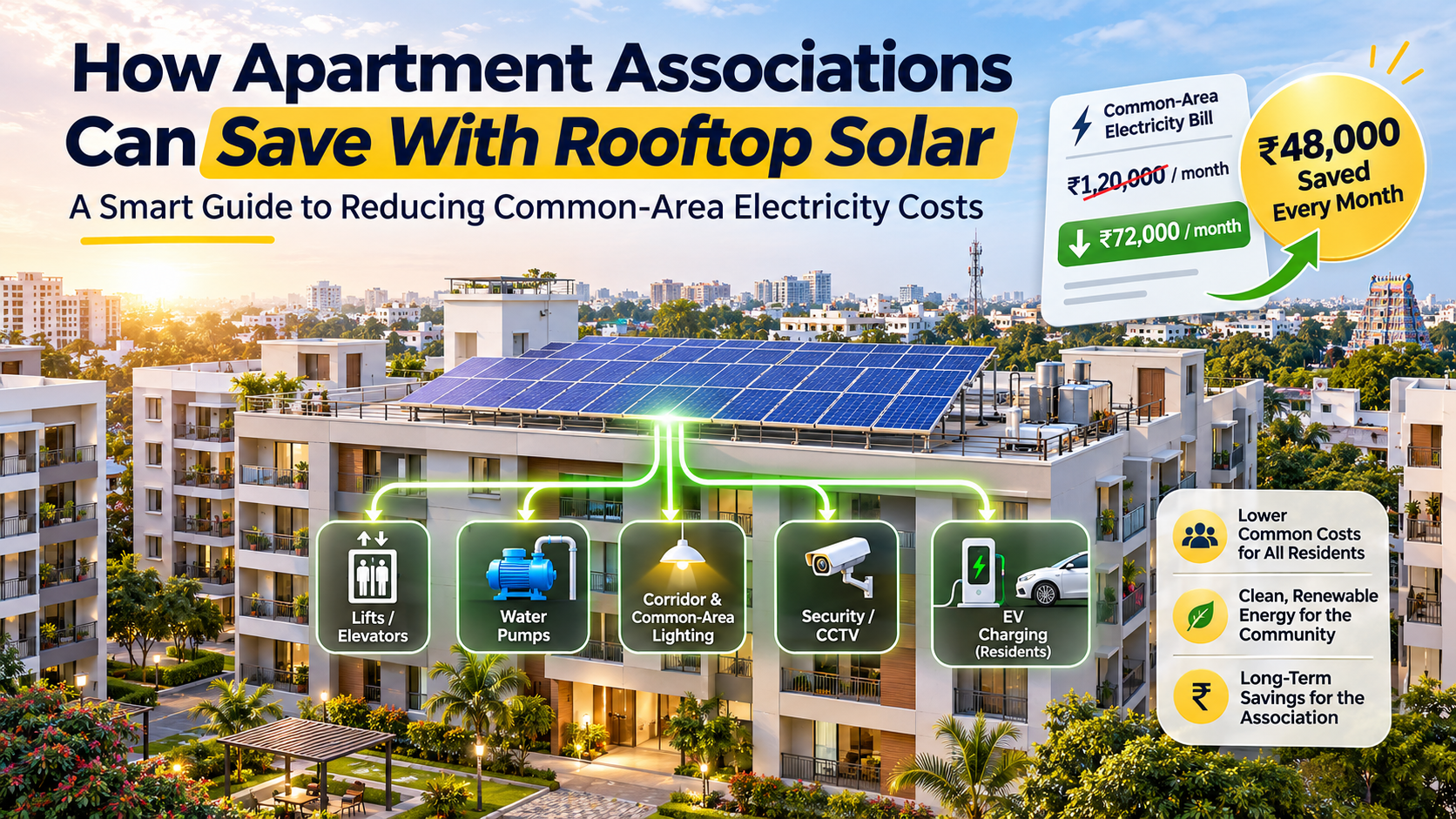
One rooftop. Multiple homes. Smarter electricity savings for the entire community.
Apartment living offers convenience, security, and shared amenities. However, maintaining these facilities comes with recurring electricity expenses.
From elevators and water pumps to corridor lighting, security systems, and electric vehicle charging stations, modern apartment complexes rely on electricity to keep their shared infrastructure running.
These expenses are generally managed by apartment owners' associations or resident welfare associations (RWAs) and recovered through monthly maintenance contributions.
As electricity requirements grow, many associations are exploring sustainable ways to reduce their operating expenses.
One effective solution is rooftop solar power for apartment common areas.
By using available rooftop space to generate electricity, residential communities can reduce their dependence on purchased grid power, manage long-term maintenance expenses, and contribute to a cleaner environment.
But how does apartment solar actually work? Can it reduce maintenance charges? Are government subsidies available?
In this guide, Daystar Solar explains how apartment associations in Chennai and across Tamil Nadu can benefit from rooftop solar installations.
1. Why Are Apartment Electricity Expenses Increasing?
Unlike individual houses, apartment complexes have electricity requirements that extend beyond residents' private consumption.
Common facilities may operate throughout the day and night, creating significant recurring costs for the association.
Some of the major electricity-consuming facilities include:
Elevators and lifts: Multi-storey residential buildings rely on elevators for everyday movement, especially during peak morning and evening hours.
Water pumping systems: Water pumps are used to fill overhead tanks, maintain water pressure, and support daily water distribution.
Common-area lighting: Staircases, corridors, parking areas, entrances, and outdoor pathways require reliable lighting.
Security equipment: CCTV cameras, automated gates, access-control systems, and security cabins require electricity.
Water treatment systems: Larger apartment communities may operate sewage treatment plants (STPs), water treatment equipment, and other essential utilities.
Electric vehicle charging: As EV adoption increases, apartment associations may need to support charging facilities for residents.
Individually, some of these loads may appear small. Together, they can create a substantial electricity bill.
Rooftop solar can help offset a portion of this shared electricity consumption.
2. How Does Rooftop Solar Work in an Apartment Complex?
A rooftop solar system converts sunlight into electricity using photovoltaic solar panels.
The generated direct current (DC) electricity is converted into alternating current (AC) through a solar inverter.
This electricity can then support eligible electrical loads connected to the apartment's common-area electricity service.
For example, solar generation may help supply:
Water pumping systems
Elevators and common utilities
Corridor and staircase lighting
Parking and outdoor lighting
Security cabins and CCTV equipment
Clubhouses and community halls
Approved EV charging infrastructure
In a typical grid-connected system, solar electricity is consumed when generation and demand occur at the same time.
When the system produces insufficient electricity, the remaining requirement is supplied by the electricity grid.
Surplus electricity may be exported under the applicable utility-approved metering arrangement.
Important: A solar system installed on an apartment association's common-area electricity connection does not automatically reduce every resident's individual household electricity bill.
The primary benefit is a reduction in the association's shared electricity expenses.
Individual apartment solar benefits require a separate eligible connection or another approved arrangement.
3. How Much Can an Apartment Association Save With Solar?
The potential savings depend on several factors, including the size of the solar plant, local sunlight conditions, electricity consumption, and the billing mechanism.
Consider a hypothetical residential apartment complex in Chennai.
Example: A 20 kW Rooftop Solar System
Particulars | Illustrative value |
|---|---|
Proposed solar capacity | 20 kWp |
Average daily generation per kWp | 4 units |
Estimated daily generation | 80 units |
Estimated monthly generation | 2,400 units |
Assumed direct consumption | 75% |
Electricity directly consumed | 1,800 units/month |
If the effective electricity cost avoided is assumed to be ₹8 per unit:
Estimated monthly direct-consumption savings:
1,800 × ₹8 = ₹14,400
Estimated annual direct-consumption savings:
₹14,400 × 12 = ₹1,72,800
The remaining 600 units in this example would be exported if they are not consumed on-site, with any financial benefit determined by the approved metering and billing mechanism.
These figures are only an illustrative calculation, not a savings guarantee.
Actual generation and financial returns depend on shading, temperature, equipment performance, common-area consumption, applicable tariffs, network charges, and other billing conditions.
For accurate financial planning, apartment associations should obtain a detailed solar feasibility assessment based on their electricity bills and demand profile.
4. How Can Solar Reduce Monthly Apartment Maintenance Charges?
One of the most attractive benefits of apartment solar is its potential to reduce recurring association expenses.
Apartment maintenance contributions are generally used to fund shared services, including electricity, security, cleaning, water supply, equipment servicing, and infrastructure maintenance.
If solar power reduces the electricity expenses associated with common facilities, the association may be able to allocate the savings more effectively.
For example, savings could help:
Reduce future increases in maintenance contributions
Build a reserve for infrastructure repairs
Support elevator or water pump maintenance
Upgrade common-area facilities
Fund other community improvements
Consider a residential community where electricity represents a significant proportion of monthly maintenance expenditure.
Reducing grid electricity consumption may provide financial relief over time.
However, solar savings do not automatically result in lower individual maintenance charges.
The final benefit depends on how the association manages its finances, installation costs, and decisions made by its members.
5. Is Government Subsidy Available for Apartment Solar in 2026?
Yes. Eligible Group Housing Societies (GHS) and Resident Welfare Associations (RWAs) can receive support under the central government's PM Surya Ghar: Muft Bijli Yojana.
The scheme includes Central Financial Assistance (CFA) for rooftop solar systems serving eligible common facilities, including EV charging.
Central Subsidy Structure
Particulars | Provision |
|---|---|
Eligible category | GHS / RWA common facilities |
Standard central assistance | ₹18,000 per eligible kWp |
Maximum supported capacity | Up to 500 kWp |
Household-linked limit | Up to 3 kWp per house |
EV charging facilities | Included for eligible common-use installations |
The capacity ceiling is subject to the scheme's aggregate rules, including rooftop solar capacity already installed by individual residents within the housing society.
Example: A Residential Community With 50 Apartments
Under the household-linked formula:
50 apartments × 3 kWp = 150 kWp
This is the theoretical household-linked subsidy capacity ceiling, before accounting for existing individual rooftop installations and other applicable conditions.
If the association proposes an eligible 20 kWp common-area installation, the indicative central assistance would be:
20 × ₹18,000 = ₹3,60,000
The actual subsidy is subject to eligibility, available supported capacity, technical requirements, approved installation, documentation, and successful processing under the scheme.
The subsidy-supported association connection must be dedicated to eligible common facilities rather than direct electricity supply to individual homes.
Any additional Tamil Nadu state assistance must be assessed separately. State residential top-up incentives should not automatically be assumed to apply to common-area society installations.
For official details, visit the PM Surya Ghar National Portal:
6. Can Apartments Use Net Metering in Tamil Nadu?
Grid-connected rooftop solar installations in Tamil Nadu are subject to applicable Tamil Nadu Electricity Regulatory Commission (TNERC) rules and the electricity distribution utility's requirements.
Depending on the eligible consumer category, solar installations may operate under arrangements such as net metering or net billing/net feed-in.
What is net metering?
Under net metering, solar electricity exported to the grid is adjusted against electricity imported from the grid according to the applicable billing rules.
This can help eligible consumers benefit from solar generation beyond the electricity they consume immediately.
What is net billing or net feed-in?
Under net billing or net feed-in, imported electricity and exported solar electricity are valued according to the applicable retail tariff and export compensation rules.
Therefore, the financial value of exported electricity may differ from the value of electricity consumed directly.
What Should Apartment Associations Check?
Apartment common-service connections in Tamil Nadu may fall under the domestic common-services tariff category.
The association should verify:
Its current electricity service category and tariff.
Whether the connection is eligible for net metering or another approved arrangement.
The sanctioned load and maximum permissible solar capacity.
Applicable network charges and other billing requirements.
The documents and approvals required for grid connection.
A correctly selected metering arrangement is important for achieving the expected financial benefit.
The Tamil Nadu rooftop solar application portal is available at:
https://www.tnebltd.gov.in/usrp/
7. How Much Rooftop Space Is Required for Apartment Solar?
Available rooftop space plays a major role in determining how much solar power an apartment community can generate.
As a preliminary planning estimate, the Tamil Nadu rooftop solar guidance indicates that approximately 10 square metres of shadow-free space may be required for each kWp of solar capacity.
Solar capacity | Approximate shadow-free area |
|---|---|
5 kWp | 50 m² |
10 kWp | 100 m² |
20 kWp | 200 m² |
30 kWp | 300 m² |
Actual space requirements vary with solar module dimensions, layout, tilt, maintenance clearance, access pathways, and rooftop obstacles.
A technical site assessment should examine:
Shading: Water tanks, neighbouring buildings, parapet walls, and other structures can affect generation.
Structural condition: The roof must safely accommodate the additional loads from solar modules, mounting structures, and wind forces.
Waterproofing: Installation methods should protect the integrity of the existing rooftop.
Safety and access: Fire safety, maintenance access, and relevant building requirements must be considered.
Future roof usage: Space needed for water tanks, equipment servicing, and other community purposes should remain accessible.
For Chennai's coastal environment, the selection of suitable mounting materials and corrosion-resistant components is also important.
A professionally designed system should use rooftop space effectively without compromising building safety or functionality.
8. Can Solar Power Apartment Lifts and Water Pumps?
Yes. Solar energy can help offset the electricity consumed by lifts, pumps, and other common facilities when they are connected to the appropriate electrical system.
However, the amount of solar electricity used by each facility depends on its operating schedule and consumption.
Lifts and Elevators
Elevators require electricity at different times throughout the day.
During daylight hours, solar generation can contribute to the building's overall common-area demand.
At night or when solar generation is insufficient, the remaining electricity is drawn from the grid.
Water Pumps
Water pumping systems can be particularly suitable for solar-powered common services when operating schedules allow them to run during periods of strong solar generation.
Coordinating pumping schedules with daytime solar production can help improve self-consumption.
Common-Area Lighting
Parking lights, corridor lights, and outdoor lighting often operate during evening and night hours.
A conventional grid-connected solar system does not generate electricity at night, but daytime generation may still contribute to billing benefits through an eligible metering arrangement.
For backup supply during power failures, a suitable hybrid inverter, battery system, and backup electrical design are required.
Solar panels alone do not provide uninterrupted power during grid outages.
9. Should Apartments Consider Solar-Powered EV Charging?
Electric vehicle charging is becoming an increasingly relevant consideration for modern apartment communities.
Where appropriate, rooftop solar can help offset part of the electricity required by shared EV charging infrastructure.
This may be particularly beneficial when vehicles are charged during daylight hours.
However, several factors should be considered:
Expected EV charging demand
Available electrical connection capacity
Charging station specifications
Solar generation and charging schedules
Electrical safety and protection
Association approval and cost allocation
Applicable subsidy and metering conditions
A solar installation should be designed around realistic charging demand rather than assuming all charging will be supplied directly by rooftop panels.
As more residents adopt electric vehicles, associations can evaluate whether their rooftop solar systems should be designed with future expansion in mind.
10. A Real-World Lesson From Chennai Apartment Associations
A January 2026 report by Chennai-based consumer organisation Citizen consumer and civic Action Group (CAG) highlighted the importance of proper solar sizing, tariff selection, and post-installation support.
At Geeyam Kalyan Apartments in R.A. Puram, a rooftop solar installation was already present, but residents were concerned about the electricity savings.
Following a review and a correction to the electricity billing arrangement, CAG reported that the apartment's common-service electricity bill decreased from approximately ₹10,000 to ₹5,000 per two-month billing period.
The reported savings followed a tariff and billing change, not simply the installation of additional panels.
This example demonstrates an important lesson for apartment associations:
A properly designed and correctly billed solar system is more valuable than simply installing the highest possible capacity.
Understanding the existing electricity connection, consumption profile, and billing mechanism is essential before making an investment.
11. What Is the Installation Process for an Apartment Solar Project?
Installing rooftop solar for an apartment association requires technical planning and coordination with the association's management committee.
Step 1: Review Electricity Consumption
Collect recent electricity bills associated with common facilities.
Analyse consumption trends, tariff categories, sanctioned load, and daytime electricity demand.
Step 2: Conduct a Rooftop Survey
A qualified solar installation team examines the available rooftop area, shading, accessibility, structural conditions, and installation feasibility.
Step 3: Select the Appropriate Solar Capacity
System sizing should reflect actual electricity consumption and future requirements.
A larger solar system is not necessarily the most cost-effective solution.
Step 4: Prepare a Financial Assessment
The proposed project should include:
Estimated installation expenditure
Expected annual solar generation
Electricity cost savings
Applicable subsidy assumptions
Operation and maintenance expenses
Estimated investment payback period
Step 5: Obtain Association Approval
The proposal should be discussed and approved according to the association's applicable bylaws and decision-making procedures.
The committee should clarify system ownership, financing, rooftop usage rights, and responsibilities for maintenance.
Step 6: Complete Utility and Scheme Formalities
The association must follow the applicable process for rooftop solar approval, subsidy registration where eligible, inspection, metering, and grid connection.
Step 7: Install and Commission the Solar System
The installation should include suitable solar modules, an inverter, mounting structures, cables, protection devices, and other required electrical components.
After installation, the system must undergo appropriate testing, inspection, and commissioning.
Step 8: Monitor Generation and Maintain the System
Solar performance should be monitored regularly.
Routine inspections, panel cleaning, and electrical maintenance help maintain system reliability and identify underperformance early.
12. Is Rooftop Solar a Good Long-Term Investment for Apartments?
Rooftop solar can provide a useful long-term benefit when it is matched to the association's electricity requirements.
Its potential advantages include:
Reduced electricity expenditure: Direct consumption of solar energy can lower purchases from the grid.
Improved budget predictability: Solar generation can reduce exposure to some future electricity tariff increases.
Better use of shared rooftop space: Available rooftops can become productive energy-generating assets.
Long-term sustainability: Solar electricity reduces reliance on conventional electricity generation.
Community-wide benefits: Savings can support the association's operational budget and maintenance planning.
However, successful projects require realistic financial assumptions.
The association must account for the installation investment, equipment warranties, future inverter replacement where required, system degradation, maintenance costs, and the actual value of solar generation.
An investment payback calculation should be based on a project-specific quotation and the applicable utility tariff.
13. Common Mistakes Apartment Associations Should Avoid
Installing solar without analysing consumption
An oversized system may export more electricity than expected, potentially reducing financial returns.
Ignoring the common-service electricity tariff
Incorrect billing or an unsuitable metering arrangement can affect expected savings.
Choosing equipment based only on the lowest quotation
Equipment quality, installation practices, electrical protection, and long-term service support are important.
Overlooking rooftop safety
A structural assessment and suitable mounting design are essential.
Assuming solar provides power during outages
Standard grid-connected solar systems require additional equipment to provide backup power.
Failing to plan maintenance
Solar systems need periodic inspections and performance monitoring even when routine maintenance requirements are relatively modest.
14. Frequently Asked Questions
Q1. Can an apartment association install solar panels on a shared rooftop?
Yes. Apartment associations can explore rooftop solar installations on common property, subject to rooftop usage rights, required association approvals, technical feasibility, and electricity utility regulations.
Q2. Can rooftop solar reduce apartment maintenance charges?
Potentially. Solar can reduce common-area electricity expenses, allowing the association to consider lower future maintenance contributions or allocate funds to other requirements.
Q3. Can rooftop solar power lifts and water pumps?
Yes, solar electricity can offset the energy consumed by these facilities when the system is appropriately connected and designed.
Q4. Is there a government subsidy for apartment solar?
Under PM Surya Ghar, eligible group housing societies and RWAs may receive central assistance of ₹18,000 per eligible kWp for common facilities, subject to the scheme's capacity ceilings and other conditions.
Q5. Do individual apartment owners receive the solar savings?
A common-area system normally reduces the association's shared electricity expenses. It does not automatically provide direct credits to individual residential electricity connections.
Q6. What happens during the rainy season?
Solar panels can generate electricity using available daylight during cloudy weather, although generation usually decreases when sunlight is reduced.
The grid supplies the additional electricity required by the building.
Q7. Does apartment solar work during power cuts?
A standard grid-connected solar system normally shuts down during a grid outage. Backup requires equipment designed for safe operation without the grid, such as a compatible hybrid system with battery storage.
Q8. How long can an apartment rooftop solar system operate?
Solar modules commonly have long-term performance warranties extending to approximately 25 years or more, depending on the manufacturer and product.
However, the inverter and other electrical components may require maintenance or replacement during the system's lifetime.
Q9. Can an existing apartment solar plant be expanded?
Yes, expansion may be possible if the inverter, electrical configuration, rooftop space, and applicable utility permissions support the additional capacity.
Q10. How can an apartment association determine the right solar capacity?
A professional assessment of electricity bills, common-area consumption, rooftop suitability, sanctioned load, and financial objectives can help identify the appropriate system size.
Conclusion: One Rooftop Can Deliver Shared Benefits
Apartment associations are responsible for maintaining essential facilities while managing the expenses shared by residents.
Rooftop solar offers an opportunity to convert available roof space into a long-term energy asset.
By generating electricity for common facilities such as lifts, water pumps, lighting, security equipment, and eligible EV charging infrastructure, apartment communities can reduce their dependence on grid electricity and work towards more sustainable operations.
Government incentives may further improve the financial feasibility of qualifying projects.
However, achieving meaningful savings requires careful system sizing, appropriate equipment, proper metering, and professional installation.
For apartment associations in Chennai and Tamil Nadu, the first step is understanding how much electricity their common facilities consume and how rooftop solar can contribute to those requirements.
Planning Rooftop Solar for Your Apartment Community?
Power Your Community. Reduce Shared Energy Costs.
At Daystar Solar, we help residential communities explore practical rooftop solar solutions suited to their energy requirements.
From rooftop assessments and system design to installation and ongoing service support, our team can help your association evaluate a suitable solar investment.
Turn your apartment rooftop into a smarter energy asset with Daystar Solar.
Contact: +91 91766 68617 / +91 91766 68632
Website: https://www.daystarsolar.co.in
Daystar Solar — Powering Your Future.