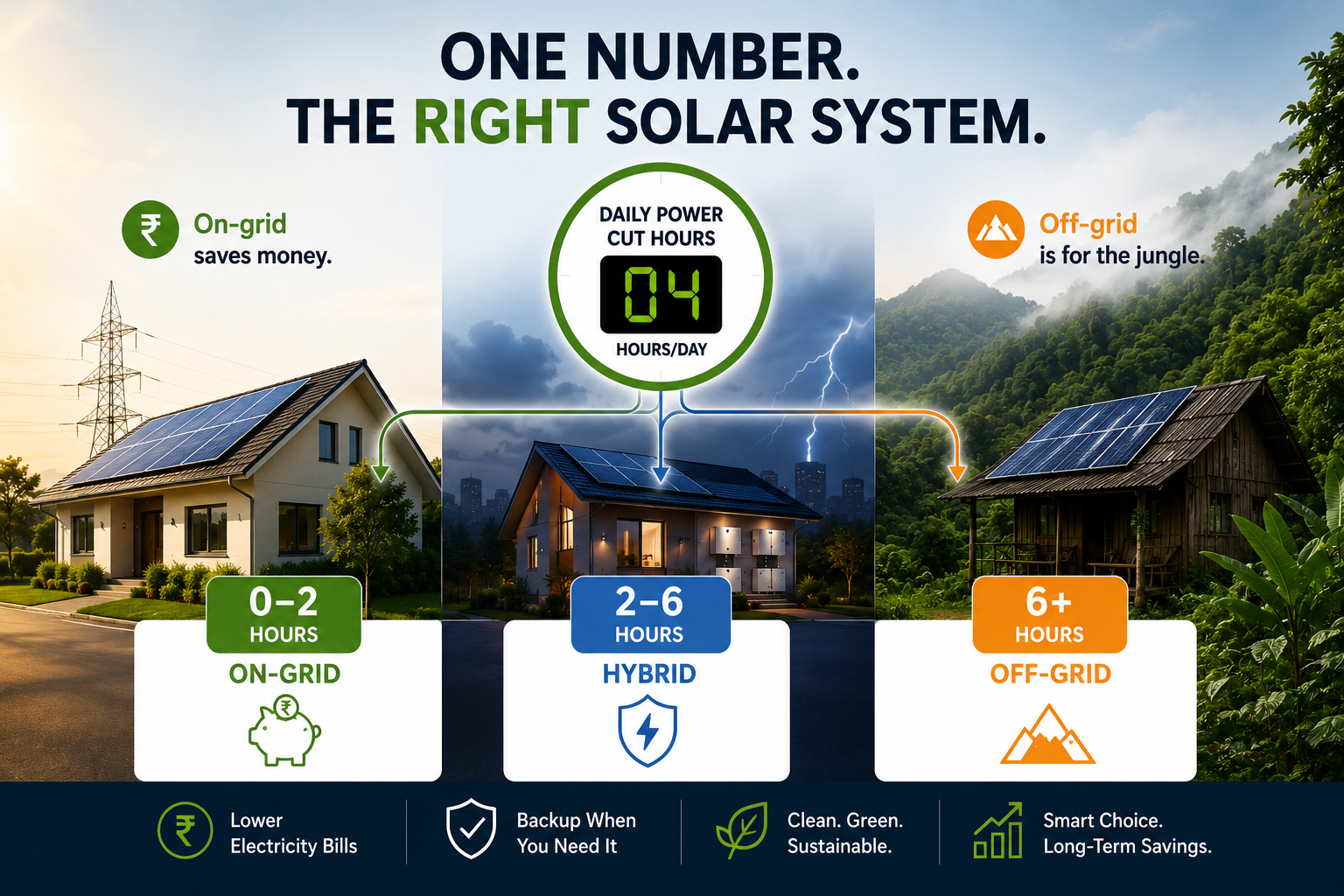
On-Grid vs Off-Grid vs Hybrid: which one is right for your home?
Every other article gives you basic information and vague advice, after reading this 10 minute blog, you will have a concrete answer on which one is the system for your use case.
You can find your system using 3 simple questions
1. How reliable is your electricity grid where you live?
a. Very stable - Outages are very rare(0 - 2 hours per month)
b. Moderate - 1 to 3 hours of outage daily
c. Frequent - 4+ hours of cuts everyday
d. No grid at all in a very remote area
2. What is your main goal with solar?
a. Reduce my Electricity bill as much as possinlle.
b. Make sure i have power even during cuts.
c. Maximize energy independence and go green
d. A balance of savings and some backup
3.What's your budget for this installation?
a. Minimize upfront cost - best ROI is the priority
b. Willing to pay more if it solves backup needs
c. Budget is flexible - want the full solution
Decision Making Framework
1. 0 to 1 hour of power cut per day
On-Grid
You don't need battery backup badly enough to justify the extra ₹1 - 2L. Use the savings to get a quicker ROI
2. 1 to 4 hour power cut per day
Hybrid
The power cuts are disruptive enough that backup is worth paying for, and solar-charged batteries eliminate your dependence on the DISCOM during peak outage hours.
3. 4 - 8 hours of power cuts per day, grid still exists
Hybrid with larger battery bank
You need more storage capacity - budget for 10 - 15 kWh of lithium ion batteries. Still cheaper than going fully off-grid.
4. No grid access at all.
Off Grid only
This is the one scenario where off-grid is the right call. Ensure you size for 2-3 days of autonomy minimum.
5. You already have an inverter and lead acid battery at home.
On Grid
Install an on-grid solar system to reduce bills. Your existing inverter + battery already handles cuts. Upgrades to hybrid later when your batteries need replacement.
6. You're in a state with poor net metering reimbursement
Hybrid over On-Grid
When your exported units aren't credited fairly, storing them in a battery and using them yourself is a better strategy than selling them back for peanuts.
How each system works
Before comparing costs and use cases, it helps to understand the fundamental difference between the three systems. The key distinction isn't just "with battery or without" - it's about what happens when the grid fails and who supplies your load requirement.
On-Grid(Grid-Tied)
Your solar panels are wired directly to the grid. During the day, your panels generate power and you use it first. Any surplus goes back to the grid and DISCOM credits you under net metering. At night or during low sun periods, you simply draw from the grid as usual.
The critical thing to understand: On grid systems have a built in safety feature called anti islanding protection When the grid goes down, your solar system automatically shuts off - even if there is sun is up. This protects any linemen on their maintenance working on downed cables. So your lights go out during a power cut, just like before as this is a safety regulation.
ADVANTAGES | DISADVANTAGES |
|---|---|
Lower Upfront Cost | Zero power during grid outages |
Highest ROI if net metering is active | Fully dependant on DISCOM reliability |
Less equipment, simpler maintenance | No benefit if net metering is poor in your state |
Eligible for full PM Surya Ghar subsidy | |
Scalable — add panels easily |
Off-Grid(Standalone)
Your home operates completely independently of the electricity grid. Solar panels charge a large battery bank throughout the day, and you draw from those batteries around the clock. Because you have no grid backup, you need enough battery capacity to power your home for 2-3 days of cloudy weather.
Off-grid is almost never the right choice for urban or semi-urban Indian homes — even those with 6+ hours of daily outages. Why? Because being partially connected to the grid still gives you a valuable safety net, and going fully off-grid means massively oversizing your battery bank.
Many people assume "off-grid = freedom from power cuts." In reality, off-grid means your solar panels and batteries must cover 100% of your energy needs — including cloudy monsoon weeks. The battery sizing required makes this extremely expensive.
Advantages | Disadvantages |
|---|---|
Complete grid independence | Highest upfront cost |
Works where no grid exists | Battery replacement every 5 - 10 years |
No electricity bill ever | Not subsidy eligible |
Require energ rationing | |
Oversized system often needed |
Hybrid (Grid-Tied + Battery)
Hybrid systems connect to both the grid and a battery bank. During the day, your solar panels charge your batteries and power your home simultaneously. During a power cut, your battery bank takes over automatically — unlike off-grid, the battery here is sized to bridge outage periods, not power your home indefinitely. When the grid returns, your batteries recharge from solar again.
Think of it this way: hybrid is what you get when you combine a grid-tied system with a solar-charged UPS. It's better than a regular UPS because the batteries are topped up by your panels, not by grid electricity.
A traditional inverter + battery setup charges from the grid — which means you're still paying for the electricity that charges your backup. A hybrid solar system charges from the sun. That's the fundamental difference.
Advantages | Disadvantages |
|---|---|
Power during outages | Higher cost than on-grid |
Batteries charged by solar | Battery adds complexity |
Reduce bill + backup | Battery must be replaced eventually |
Eligible for partial subsidy | ROI lower than pure on grid |
Export to grid when battery is full |
Side by Side comparison
Factor | On-Grid | Off-Grid | Hybrid |
|---|---|---|---|
Battery Needed? | No | Yes - Large Bank | Yes - moderate |
Works during power cuts | No | Yes | Yes |
Can Export to grid? | Yes | No | Yes(When battery full) |
PM Surya Ghar Subsidy? | Full(₹30 - 78k) | Not Eligible | Partial(Panels only) |
Best for | Stable grid, bill reduction | Remote areas, no grid | Frequent outages, 2-6hrs per day |
Upfront cost(5 kW) | ₹2-3lakhs | ₹5-8lakhs | ₹3.5 - 5lakhs |
Maintenance complexity | Low | High | Medium |
Battery Replacement | None | ₹1-3L every 5 to 7 years | ₹50k-1.5L every 7 - 10 years |
Best ROI Scenario | Good net metering in your state | No grid access at all | Frequent cuts, no good net metering |
Grid Requirement | Yes | No | Yes |
The payback math changes dramatically once you factor in battery replacement. A hybrid system's second battery replacement (year 10–14) can cost as much as your original battery. Always calculate total cost of ownership over 25 years, not just sticker price.
On-Grid vs Hybrid: The honest ROI comparison
Let's say you have 2 hours of daily power cuts and install a 5kW system. On-Grid saves you approximately ₹4000 - ₹6000 per month in electricity costs. Hybrid saves you the same amount plus eliminates generator fuel or inverter battery costs - but costs ₹1-2L more upfront. If you're currently spending ₹800-1500 per month on generator fuel and inverter battery maintenance, hybrid's extra cost starts to make real sense.
Frequently Asked Questions
1. Can i convert my on-grid system to hybrid later?
Yes, in most cases — but it depends on your inverter. Some on-grid inverters can be upgraded with a battery ready kit or a separate hybrid inverter can be added. However, if your inverter isn't battery-compatible, you'll need to replace it (typically ₹40–80K). Always ask your installer about future hybrid upgrade compatibility before buying an on-grid inverter.
2. My building has very unreliable power - should I go off grid
Almost certainly not. Unless your grid is truly unavailable (not just unreliable), hybrid is the better choice. Off-grid requires massive battery banks to survive cloudy periods, which dramatically increases cost and complexity. A well-sized hybrid system with a 10–15 kWh lithium battery bank can handle 6–8 hours of daily cuts without depending on the grid at all during those hours.
3. Does a hybrid system export to grid?
Yes- once your battery bank is fully charged, surplus solar energy is exported to the grid and you earn net metering credits, just like an on-grid system. The difference is that your battery is filled first before any excess goes to the grid.
4. Which battery is better for hybrid solar - lithium or lead-acid?
Lithium (LFP — lithium iron phosphate) is significantly better for most homeowners: it lasts 3–4x longer (3,000–5,000 cycles vs 500–800 for lead-acid), requires no maintenance, tolerates partial charging better, and doesn't emit hydrogen gas. The upfront cost is 2–3x higher than lead-acid, but the total cost over 10 years is usually lower. Lead-acid still makes sense if your budget is very constrained and you're comfortable replacing batteries every 4–5 years.
5. How do i know how many kW of solar panels I need?
Look at your last 12 months of electricity bills and find your average monthly units consumed (kWh). Divide that by 120 (average monthly peak sun hours for most of India). The result is your approximate required panel capacity in kW. For example: 600 units per month / 120 = 5kW system. For hybrid, size your battery to cover your critical loads during your average outage hours - not your full daily consumption.
6. Will solar panels work during monsoon?
Yes — solar panels still generate electricity on cloudy or overcast days, though at reduced output (typically 20–40% of rated capacity). Production does dip during heavy monsoon months. This is why off-grid systems require large battery banks to bridge low-production periods, and why on-grid and hybrid systems benefit from the grid as a fallback during extended overcast spells.